1. Executive summary
What the 2026 ballot delivered
- 109 women federal deputies, 21.2% of the Câmara dos Deputados (Chamber of Deputies). A record; there were 45 in 2010 and 1 in 1933.
- 12 women senators elected for 54 seats (22.2%). In 2022 it was 4 out of 27.
- 19 women senators from 2027 (23.5% of the Senado Federal (Federal Senate)), the largest women's caucus in the history of the house.
- 218 women state and district deputies (20.6% of the 1,059 seats); there were 191 in 2022.
- 3 women governors (Raquel Lyra, PE; Celina Leão, DF; Mailza Assis, AC) and 14 women vice-governors.
- No woman in the final race for the Presidency: 2 of the 14 presidential candidacies and 6 of the 14 for vice-president were women's; the runoff had two all-male tickets.
- 3 states with no woman federal deputy: Distrito Federal, Piauí and Roraima. Acre elected no woman state deputy.
- 47 newcomers among the 109; 58 reelected (elected in 2022 and again in 2026, by CPF, the individual taxpayer ID) and 4 returning after an earlier term.
And in the municipalities (2024): 18.3% women city councilors and 13.3% women mayors; 727 councils with no woman.
The main takeaways
- The caucus grew and changed its profile: of the 109, 47 are on the left, 44 on the right and 18 in the center. Left and right are close, and which one leads depends on how the parties are classified (chapter 10); the center shrank.
- The candidacy quota is met; the bottleneck is the election. A woman candidate for federal deputy had a 4.1% chance of being elected; a man, 8.9%.
- PL transferred 25.7% of the electoral fund to its women lead candidates, below the party's share of women candidates (33.5%). It only exceeds that share when adding women running as vice or alternate on men's tickets (35.8%).
- The elected women's votes are more concentrated than the elected men's: half of a woman deputy's votes come, at the median, from 5 municipalities; for a man deputy, from 9.
- The Senate of 2027 will have more women than ever and will be the most right-leaning of the period (48 of 81 seats by party label). In the Senate, the bottleneck is the candidacy: women candidates were elected at the same rate as men candidates.
- Race weighs as much as sex: Black women were 18.3% of candidacies and are 6.6% of the Chamber; their chance (2.6%) is less than half that of white women (5.6%) and one fifth that of white men. In the Assemblies, the same yardstick: 3.6% against 15.6%.
- The disadvantage lies with those who arrive without an elected office. Those who already held office compete on almost equal terms, and the first office is municipal: that is where Brazil lags furthest behind the region (16% women city councilors against 27.2% in Latin America, according to CEPAL, the UN Economic Commission for Latin America and the Caribbean).
- Brazil remains among the last in Latin America in the Legislature (in 2027, second to last of 19 countries, ahead only of Guatemala) and stands above the world average in women ministers. The difference between the two is the rule: the cabinet is chosen; the seat depends on an open list with no reserved seats.
- Political violence grew faster than the caucus. Recorded cases multiplied almost fivefold in two years, and there is still no known final conviction under Law 14,192/2021.
- The public is ahead of the parties: 62% supported reserving seats in Parliament (DataSenado, 2022), and 89% want more women candidates (Ipec, 2025); reserved seats have been stalled in the Senate since 2021.
2. A hundred years of presence: from 1927 to 2027
On October 25, 2027, Rio Grande do Norte Law 660, which gave the state's women the right to vote and to stand for election, turns one hundred. On February 24, 2027, the 1932 Electoral Code, which extended that right to the whole country, turns 95. The legislature elected in 2026 therefore begins in the centenary year.
The milestones
| Date | Milestone | Source |
|---|---|---|
| 1824 | The Imperial Constitution recognizes only male citizens as voters. Article 46 makes the princes of the Imperial House senators by right at age 25; under that rule, Princess Isabel became, in theory, the country's first "woman senator" on Jul 29, 1871, when she turned 25, without ever being elected | 1824 Constitution, art. 46; Agência Senado (Jul 2026) |
| 1891 | The first republican Constitution does not expressly ban women's vote, but women's requests to register are denied | 1891 Constitution, art. 70; Marques, "O voto feminino no Brasil" (Edições Câmara) |
| Oct 25, 1927 | Rio Grande do Norte Law 660 gives women the right to vote and to stand for election in the state; in November, Celina Guimarães Vianna registers to vote in Mossoró, the country's first woman voter | TSE (Aug 1, 2024); Agência Senado (Oct 10, 2022) |
| 1928 | Alzira Soriano is elected mayor of Lajes (RN), with 60% of the votes, at age 32: the first woman mayor in Brazil and in Latin America (took office on Jan 1, 1929) | TSE (Aug 1, 2024) |
| Feb 24, 1932 | Electoral Code (Decree 21,076): women's right to vote and to run nationwide, secret ballot and creation of the Electoral Justice system. The date became the Day of the Conquest of Women's Suffrage (Law 13,086/2015) | Agência Senado (Feb 26, 2024) |
| May 3, 1933 | Election of the Constituent Assembly, the first in which women vote and are voted for nationwide. Carlota Pereira de Queirós (SP), a physician, is the first woman federal deputy | Chamber, "A 2ª República" |
| Jul 16, 1934 | The Constitution incorporates women's vote, compulsory only for women in paid public office | 1934 Constitution, art. 109 |
| 1934 | Antonieta de Barros is elected state deputy in Santa Catarina, the first Black woman elected in the country; Maria do Céu Fernandes (RN) is the first woman state deputy | Agência Senado (Feb 26, 2024); TRE-SC; TSE |
| 1936 | Bertha Lutz, an alternate, takes a seat in the Chamber | Agência Câmara (Oct 15, 2018) |
| 1946 | The 1946 Constituent Assembly has no women | Chamber, Consultoria Legislativa (2011) |
| Jul 15, 1965 | The Electoral Code in force (Law 4,737) makes voting compulsory for women too | Agência Senado (Feb 26, 2024) |
| May 31, 1979 | Eunice Michiles (AM) takes office as the first woman senator, as an alternate | Agência Senado (May 7, 2019) |
| 1981 | Laélia de Alcântara (AC), the first Black woman senator, takes office as an alternate | Agência Senado (Feb 26, 2024) |
| 1990 | Júnia Marise (MG) and Marluce Pinto (RR) are the first women senators elected by popular vote (took office in 1991) | Agência Senado (Oct 10, 2022) |
| Dec 1990 | Cnéa Cimini Moreira de Oliveira, appointed to the TST (Superior Labor Court), is the first woman on a higher court | Justiça & Cidadania, issue 173 (Jan 2015) |
| 1994 | Benedita da Silva (PT-RJ) and Marina Silva (PT-AC) are the first Black women elected senators (to full seats, not as alternates), in the Oct 3, 1994 election; they take office on Feb 1, 1995 | TSE (1994 election); Senado (open data) |
| 1994 | Roseana Sarney (MA) is the first woman governor elected | Revista de Estudos Eleitorais, TRE-PE (2018) |
| 1995 and 1997 | First candidacy quota (20% in the 1996 municipal elections) and its extension to all proportional elections (chapter 13) | Law 9,100/1995; Law 9,504/1997 |
| Jun 30, 1999 | Eliana Calmon is the first woman justice of the STJ (Superior Court of Justice) | Justiça & Cidadania, issue 173 (Jan 2015) |
| 2000 | Ellen Gracie, the first woman justice of the STF (and the first to preside over it, from 2006 to 2008) | STF (Aug 8, 2011) |
| 2007 | Maria Elizabeth Rocha, appointed on Mar 7, 2007, is the first woman justice of the STM (Superior Military Court); in 2014 she becomes the first to preside over it, and she presides over it again today | STM (court composition); Justiça & Cidadania, issue 173 (Jan 2015) |
| Oct 31, 2010 | Dilma Rousseff is elected the first woman president of the Republic | Chamber (Oct 31, 2010) |
| 2012 | Cármen Lúcia is the first woman president of the TSE | Migalhas (Mar 7, 2012) |
| 2014 | Candidacies begin declaring color or race at registration, and the TSE begins publishing this data | TSE Res. 23,405/2014 |
| Sep 1, 2016 | Laurita Vaz is the first woman president of the STJ | Empório do Direito (Sep 5, 2016) |
| 2020 | Maria Cristina Peduzzi is the first woman president of the TST | A Gazeta (2019) |
| 2021 | Political violence against women becomes a crime (Law 14,192) | Planalto |
| Oct 4, 2026 | 109 women federal deputies and 12 women senators elected, both records | TSE; Rádio Câmara (Oct 5, 2026) |
Women federal deputies elected, 1933 to 2026
| Election | Women elected | % of seats | Votes of the women elected | % of the votes of all elected |
|---|---|---|---|---|
| 1933 | 1 | 0.4% | ||
| 1934 | 2 | |||
| 1945 | 0 | 0% | ||
| 1950 | 1 | 0.3% | ||
| 1954 | 3 | 0.9% | ||
| 1958 | 2 | 0.6% | ||
| 1962 | 2 | 0.5% | ||
| 1966 | 6 | 1.5% | ||
| 1970 | 1 | 0.3% | ||
| 1974 | 1 | 0.3% | ||
| 1978 | 4 | 1.0% | ||
| 1982 | 8 | 1.7% | ||
| 1986 | 26 | 5.3% | ||
| 1990 | 29 | 5.8% | ||
| 1994 | 32 | 6.2% | 1,487,659 | 5.9% |
| 1998 | 29 | 5.6% | 2,135,778¹ | 6.0% |
| 2002 | 42 | 8.2% | 4,481,238 | 8.8% |
| 2006 | 45 | 8.8% | 4,071,185 | 7.6% |
| 2010 | 45 | 8.8% | 5,419,259 | 9.2% |
| 2014 | 51 | 9.9% | 4,700,186 | 8.1% |
| 2018 | 77 | 15.0% | 7,917,409 | 14.9% |
| 2022 | 90 | 17.5% | 11,625,926 | 19.2% |
| 2026 | 109 | 21.2% | 16,661,739 | 23.8% |
- Votes: in 2026 the 109 women elected received 16.7 million votes, 23.8% of the votes of everyone elected; in 1994, the 32 women elected received 1.5 million (5.9%).
- Fifty years with fewer than ten women deputies: from 1933 to 1982, the Chamber never had more than 8 women elected.
- The 1986 Constituent Assembly nearly tripled the caucus (from 8 to 26), and the caucus stayed close to 30 for four more elections, until 1998, even with the candidacy quota already in force.
- From 2014 to 2026, the caucus more than doubled (from 51 to 109), after the money rule (2018) and the double-counted vote (2022).
- Since 1934, 335 women have held office as federal deputy; men, 7,568 (Secretaria da Mulher, the Women's Secretariat of the Chamber, page "Mulheres na Câmara").
Sources: up to 2006, Piovesan's table reproduced by the Chamber's Consultoria Legislativa (Legislative Advisory Office; Ana Luíza Backes, Mar 10, 2011) and CFEMEA (Centro Feminista de Estudos e Assessoria, "Mulheres eleitas em 2014"); from 2010 on, TSE (open data). The percentages before 1986 use the total number of seats in each election: 254 in 1933 (Constituent Assembly, including the class representatives), 286 in 1945, 304 in 1950, 326 in 1954 and 1958, 404 in 1962 and 409 in 1966 (Câmara, "A 2ª República" and "A 4ª República"); 310 in 1970, 364 in 1974, 420 in 1978 and 479 in 1982 (TSE, Estudos Eleitorais, "A (in)definição do número de deputados federais por estado"). The 1934 total was not checked.
Votes of the women elected: sum of the 1st-round nominal votes of the women deputies elected; "% of the votes of all elected" is their share of the total votes of everyone elected (TSE, vote by candidate, 1994 to 2026). Before 1994 the TSE does not publish the vote by candidate. ¹ In 1998 the TSE file gives the result status of 508 of the 513 elected and of 28 of the 29 women elected; the sum covers those 28.
Women senators elected
| Election | Seats | Women elected | % of seats | Votes of the women elected | % of the votes of all elected |
|---|---|---|---|---|---|
| 1990 | one third of the seats | 2 | |||
| 1994 | 54 | 4 | 7.4% | 3,525,475 | 7.6% |
| 1998 | 27 | 2 | 7.4% | 700,634¹ | 2.3% |
| 2002 | 54 | 8 | 14.8% | 7,354,143 | 9.3% |
| 2006 | 27 | 4 | 14.8% | 2,047,050 | 4.8% |
| 2010 | 54 | 7 | 13.0% | 20,577,508 | 19.5% |
| 2014 | 27 | 5 | 18.5% | 2,955,523 | 6.0% |
| 2018 | 54 | 6 | 11.1% | 10,386,739 | 12.7% |
| 2022 | 27 | 4 | 14.8% | 4,000,395 | 8.6% |
| 2026 | 54 | 12 | 22.2% | 17,219,306 | 15.3% |
- Votes in the Senate: in 2026 the 12 women elected received 17.2 million votes, 15.3% of the votes of everyone elected, below their share of the seats (22.2%).
In 1990 the election renewed one third of the Senate; since then renewal alternates between one third (27 seats) and two thirds (54). Up to 2006, CFEMEA (2014) and Agência Senado; from 2010 on, TSE (open data). For 1994, TSE (open data): 54 seats and 4 women elected (Benedita da Silva, RJ; Marina Silva, AC; Emília Fernandes, RS; Marluce Pinto, RR).
Votes of the women elected: sum of the 1st-round votes of the women senators elected; "% of the votes of all elected" is their share of the total votes of everyone elected (TSE, vote by candidate, 1994 to 2026). In two-seat elections each voter casts two votes. Only women elected to full seats count: an alternate is elected on the senator's ticket, receives no votes of her own and is not counted when she takes the seat (alternates who took office appear in chapter 4). ¹ In 1998 the TSE file gives the result status of 26 of the 27 elected; the 2 women elected are among them.
The electorate has been majority female since 2000
| Year | Women voters | % of the electorate |
|---|---|---|
| 1994 | 46.8 million (of 94.8 million) | 49.4% |
| 1996 | 50.2 million | 49.6% |
| 1998 | 52.8 million | 49.8% |
| 2000 | 55.4 million (of 109.8 million) | 50.5% |
| 2002 | 58.6 million | 50.8% |
| 2006 | 64.9 million | 51.5% |
| 2010 | 70.4 million (of 135.8 million) | 51.8% |
| 2014 | more than 74 million | 52.1% |
| 2018 | 77.3 million | 52.5% |
| 2022 | 82.4 million (of 156.5 million) | 52.6% |
| 2026 | 83.8 million (of 158.7 million) | 52.8% |
- In 2000 women voters outnumbered men voters for the first time: 55.4 million women and 54.2 million men. In 1994 there were still 0.9 million more men.
Sources: 1994 to 2010 and 2022, TSE, electorate profile (open data, files perfil_eleitorado_<ano>; less than 0.3% of the electorate with no sex recorded); 2014 and 2018, TSE via Agência Câmara and Agência Senado; 2026, TSE (Sep 4, 2026).
Reading: women have been the majority of those who vote for more than 25 years and are still one fifth of those voted into Congress. The gap narrowed more in the last twelve years than in the previous eighty.
3. Chamber of Deputies: from 45 to 109 women deputies in four elections
| Election | Women deputies | % of the 513 |
|---|---|---|
| 2010 | 45 | 8.8% |
| 2014 | 51 | 9.9% |
| 2018 | 77 | 15.0% |
| 2022 | 90 | 17.5% |
| 2026 | 109 | 21.2% |
- 64 more seats in 16 years (+142%), an average of 3.1 percentage points per election.
- If this pace holds, the Chamber would reach parity around 2063.
Source: TSE, open data 2010 to 2022 and 2026 data (Nov 3). The TSE is the source of all counts in this study.
Candidacies also rose, and the gap to seats narrowed
| Election | Women candidates registered | % of candidacies | % of seats | Gap (points) |
|---|---|---|---|---|
| 2010 | 1,335 of 6,015 | 22.2% | 8.8% | 13.4 |
| 2014 | 2,270 of 7,136 | 31.8% | 9.9% | 21.9 |
| 2018 | 2,767 of 8,607 | 32.1% | 15.0% | 17.1 |
| 2022 | 3,717 of 10,630 | 35.0% | 17.5% | 17.5 |
| 2026 | 2,871 of 7,803 | 36.8% | 21.2% | 15.6 |
- In 2010, the quota was not yet met in the national total (22.2%). Since 2014 it has been, and the share of women candidates changed little (from 31.8% to 36.8%); what changed was the share of seats, which doubled.
- Registered candidacies, including those later rejected or withdrawn. Among those that made it to the ballot in 2026, women were 37.0% (chapter 13).
Source: TSE, candidacy query from 2010 to 2026.
Votes for women, from 1994 to 2026
| Election | Federal deputy: % of votes | Women deputies: % of seats | State and district deputy: % of votes |
|---|---|---|---|
| 1994 | 5.5% | 6.2% | 6.8% |
| 1998 | 6.2% | 5.6% | 9.2% |
| 2002 | 8.6% | 8.2% | 12.2% |
| 2006 | 7.9% | 8.8% | 11.2% |
| 2010 | 9.5% | 8.8% | 12.1% |
| 2014 | 9.6% | 9.9% | 11.7% |
| 2018 | 16.2% | 15.0% | 18.7% |
| 2022 | 20.9% | 17.5% | 20.3% |
| 2026 | 24.0% | 21.2% | 25.4% |
- In 32 years, the share of candidate votes cast for women running for federal deputy rose from 5.5% to 24.0%. The largest rise, from 9.6% to 16.2%, coincides with 2018, the first year of the rule reserving 30% of the Electoral Fund for women.
- Until 2014, the share of votes and the share of seats moved together. Since 2018, women have received more votes than seats: in 2026, 24.0% of the votes and 21.2% of the seats.
- Candidate votes in the first round, excluding party-list votes. Before 1994, the TSE does not publish votes by candidate as open data.
Source: TSE, votes by candidate and candidacy data from 1994 to 2026 (2026 data as of Nov 3, 2026); Instituto Aliá's calculation.
4. Federal Senate: 12 elected and the largest women's caucus in history
Women elected in each election
| Election (checked against the TSE) | Seats | Women elected | % |
|---|---|---|---|
| 2010 | 54 | 7 | 13.0% |
| 2014 | 27 | 5 | 18.5% |
| 2018 | 54 | 6 | 11.1% |
| 2022 | 27 | 4 | 14.8% |
| 2026 | 54 | 12 | 22.2% |
The 12 women elected in 2026
| Senator | Party-State | Votes | Camp |
|---|---|---|---|
| Marília Campos | PT-MG | 3,990,864 | Left |
| Luizianne Lins | REDE-CE | 2,822,806 | Left |
| Carol de Toni | PL-SC | 2,694,918 | Right |
| Marília Arraes | PDT-PE | 2,325,127 | Left |
| Gracinha Caiado | UNIÃO-GO | 1,458,522 | Right |
| Michelle Bolsonaro | PL-DF | 938,496 | Right |
| Marina JHC | PSDB-AL | 926,860 | Center |
| Bia Kicis | PL-DF | 886,616 | Right |
| Samanda de Lula | PT-RN | 635,924 | Left |
| Rayssa Furlan | PODE-AP | 264,799 | Center |
| Mara Rocha | REPUBLICANOS-AC | 157,104 | Right |
| Teresa Surita | MDB-RR | 117,270 | Center |
Votes: TSE tally of Oct 5; names and parties checked against the Nov 3 data.
The women's caucus from February 2027: 19 women senators (23.5%)
- 12 elected in 2026 (above).
- 7 with terms until 2031: Damares Alves (REPUBLICANOS-DF), Tereza Cristina (PP-MS), Teresa Leitão (PT-PE), Professora Dorinha (UNIÃO-TO), Ana Paula Lobato (PSB-MA, in Flávio Dino's seat), Jussara Lima (PSD-PI, alternate of Wellington Dias) and Cheila Moreira (PT-AM).
- What changed with the runoff: Omar Aziz (PSD-AM) was elected governor of Amazonas and leaves the Senate; the seat goes to his first alternate, Cheila Moreira. Professora Dorinha lost the race for governor of Tocantins and remains a senator. Alan Rick (AC) also lost and remains in the Senate.
- What may still change: Jussara Lima holds the seat of Wellington Dias, who is on leave to head a ministry; if he returns to the Senate, the caucus drops to 18 (22.2%).
- Who leaves in January 2027 (9): Leila Barros (DF), Eliziane Gama (MA), Soraya Thronicke (MS) and Zenaide Maia (RN) lost the election; Daniella Ribeiro (PB) and Mara Gabrilli (SP) ran for another office; Dra. Eudócia (AL), Roberta Acioly (RR) and Ivete da Silveira (SC) end the period as alternates.
Source: TSE, data of Nov 3, 2026; Senate, open data (sitting senators and Omar Aziz's terms, accessed on Nov 3, 2026).
When she is a candidate, a woman is elected as often as a man in the Senate
| Election | Women candidates | % of candidacies | Women elected | Women's chance | Men's chance |
|---|---|---|---|---|---|
| 2010 | 36 of 272 | 13.2% | 7 | 19.4% | 19.9% |
| 2014 | 35 of 185 | 18.9% | 5 | 14.3% | 14.7% |
| 2018 | 64 of 385 | 16.6% | 6 | 9.4% | 15.0% |
| 2022 | 58 of 243 | 23.9% | 4 | 6.9% | 12.4% |
| 2026 | 70 of 319 | 21.9% | 12 | 17.1% | 16.9% |
- In 2026, 12 of the 70 women candidates were elected, and 42 of the 249 men candidates. For the first time since 2014, their rate matches men's.
- The Senate's bottleneck is the parties' choice: with one or two seats per state and a majority-rule election, the seat depends on the party fielding the woman as its main candidate. In 2026, less than a quarter of the candidacies were women's.
Registered candidacies (TSE, candidacy query).
Alternates: the Senate's side door has narrowed
- Of the 108 alternate slots on the tickets elected in 2026 (1st and 2nd alternate for the 54 seats), 20 are held by women (18.5%): 10 first and 10 second alternates. In 2018, with the same number of seats, there were 34 (31.5%).
- It matters because an alternate becomes a senator: three of the seven women senators with terms until 2031 reached the Senate as alternates (Ana Paula Lobato, Jussara Lima and Cheila Moreira), as did the country's first woman senator, Eunice Michiles, in 1979.
- In Mexico, the lead candidate and the alternate must be of the same sex since ruling 12624 of 2011, to prevent an elected woman from resigning in favor of a man alternate (chapter 9). In Brazil there is no sex rule for Senate alternates.
The first Black women senators
- The country's first Black woman senator was Laélia de Alcântara (AC), who took office as an alternate in 1981.
- Benedita da Silva (PT-RJ) and Marina Silva (PT-AC) are the first Black women elected senators (to full seats, not as alternates), in 1994; they took office in 1995. Benedita received 2,249,861 votes and Marina 64,436; each was the most-voted Senate candidate in her state.
- The TSE has recorded color or race only since 2014; in the 2014 and 2022 records, both declare themselves Black (preta).
Sources: TSE, candidacy query and vote by municipality and zone for 1994; Senado, Benedita da Silva's profile and open data (terms of the 50th legislature); Agência Senado, Arquivo S, "A pouco conhecida história da 1ª senadora negra do Brasil".
Vice governors and alternates: why they matter
- In the Senate, the two alternates are elected on the same ticket as the senator, in a majoritarian race, and take the seat whenever the senator goes on leave or leaves office, which can happen at any point in the eight-year term. That is how the first woman senator, Eunice Michiles, arrived in 1979, and it will happen again in 2027 in Amazonas: Omar Aziz was elected governor and his first alternate, Cheila Moreira, takes the seat.
- In the Chamber, alternates come from the party or federation list, in order of votes, and an alternate only takes office if a member steps away, which may not happen in the four years. Under the Chamber's Internal Rules, posts such as a committee chair and a seat in the Secretaria da Mulher belong to members in office. The Senate has no such restriction, as in Augusta Brito's case at the Women's Special Ombudsman Office (chapter 18).
- The vice governorship is also a way in: Celina Leão (PP-DF) was vice governor from 2023, took over the Federal District government on Mar 30, 2026, when Ibaneis Rocha resigned, and was reelected in October. In 2026, 14 women vice governors were elected (chapter 8).
Sources: TSE; Internal Rules of the Chamber of Deputies; Correio da Manhã (Mar 2026) and Poder360 (Oct 25, 2026), on Celina Leão.
Source: TSE, candidacy query 2018 and 2026 (offices of 1st and 2nd alternate).
5. The states
Women federal deputies elected by state, 2010 to 2026
| State | 2010 | 2014 | 2018 | 2022 | 2026 |
|---|---|---|---|---|---|
| AC | 2 | 1 | 4 | 3 | 2 |
| AM | 1 | 1 | 0 | 0 | 1 |
| AP | 3 | 3 | 3 | 2 | 3 |
| PA | 1 | 3 | 1 | 5 | 4 |
| RO | 1 | 2 | 3 | 2 | 3 |
| RR | 1 | 2 | 2 | 1 | 0 |
| TO | 1 | 3 | 2 | 0 | 1 |
| AL | 2 | 0 | 1 | 0 | 1 |
| BA | 1 | 3 | 3 | 5 | 6 |
| CE | 1 | 2 | 1 | 3 | 5 |
| MA | 1 | 1 | 0 | 3 | 5 |
| PB | 1 | 0 | 1 | 0 | 1 |
| PE | 2 | 1 | 1 | 3 | 6 |
| PI | 1 | 2 | 4 | 1 | 0 |
| RN | 2 | 1 | 1 | 1 | 3 |
| SE | 0 | 0 | 0 | 2 | 2 |
| DF | 2 | 1 | 5 | 2 | 0 |
| GO | 2 | 2 | 2 | 6 | 5 |
| MS | 0 | 1 | 2 | 1 | 4 |
| MT | 0 | 0 | 1 | 2 | 3 |
| ES | 4 | 0 | 3 | 1 | 2 |
| MG | 1 | 5 | 4 | 9 | 11 |
| RJ | 4 | 6 | 10 | 9 | 10 |
| SP | 6 | 6 | 11 | 14 | 16 |
| PR | 2 | 2 | 5 | 4 | 4 |
| RS | 2 | 1 | 3 | 6 | 5 |
| SC | 1 | 2 | 4 | 5 | 6 |
States with no woman deputy: 2010: 3 (SE, MS, MT); 2014: 5 (AL, PB, SE, MT, ES); 2018: 3 (AM, MA, SE); 2022: 4 (AM, TO, AL, PB); 2026: 3 (RR, PI, DF). Sergipe went three consecutive elections without any (2010 to 2018).
Three states without a woman deputy and Mato Grosso do Sul with half of its delegation
- Distrito Federal: 5 women deputies in 2018, 2 in 2022, none in 2026 (8 seats). Even so, all three majoritarian posts of 2026 went to women: the governorship, with Celina Leão (PP), and both Senate seats, with Michelle Bolsonaro and Bia Kicis (PL). Since Damares Alves (REPUBLICANOS) holds a term until 2031, from 2027 all three of the DF's Senate seats will be held by women, the only such case in the country.
- Piauí: 4 women deputies in 2018, 1 in 2022, none in 2026 (10 seats). The woman elected in 2022, Rejane Dias (PT), the state's most-voted candidate, never served: she resigned to take a seat as a member of the Piauí Court of Accounts, and the seat went to the alternate Merlong Solano (PT). In practice, Piauí has had no woman federal deputy since 2023. According to the TSE, the state also elected none in 1994, 1998 and 2006; in 2002 it elected Francisca Trindade (PT).
- Roraima: 2 in 2018, 1 in 2022, none in 2026 (8 seats). For the Senate, it elected Teresa Surita (MDB).
- Sources: TSE, candidacy query 1994 to 2026; Congresso em Foco (Feb 1, 2023), on Rejane Dias's resignation.
- Highest share: MS 4 of 8 (50%); SC 6 of 16 (38%); AP, MT, RN and RO 3 of 8 (38%); GO 5 of 17 (29%).
- Lowest, among those that elected any: PB 1 of 12 (8%); AL 1 of 9 (11%); AM and TO 1 of 8 (13%).
Aliá Ranking of the states: every office, the chance and the money
Existing state rankings look at one office at a time (women mayors, councillors or deputies by state), and the Centro de Liderança Pública's ranking measures gender equity in state public employment. The Aliá Ranking brings together, in each state, every elected office at all three levels and adds two measures that a count of women elected does not show: women candidates' chance of election and the share of the Electoral Fund they received.
- Presence (50% of the score): average of six offices (Chamber 2026, Senate from 2027, Assembly 2026, governor and lieutenant governor 2026, mayors 2024 and city councils 2024). Each office scores the share of women relative to parity: 50% women gives the top score. In the Federal District, with no municipalities, four offices count.
- Success (25%): chance of election of women candidates for federal and state deputy divided by that of men, capped at equality.
- Funding (25%): share of the Electoral Fund transferred by parties to women candidates for deputy divided by the share of women candidates, capped at equality.
| Rank | State | Index | Presence | Success | Funding | Chamber | Senate | Assembly | Government | Mayors | City councils |
|---|---|---|---|---|---|---|---|---|---|---|---|
| 1 | RN | 75.8 | 65.7 | 71.9 | 100.0 | 3/8 | 1/3 | 7/24 | 1/2 | 42/167 | 362/1655 |
| 2 | CE | 72.0 | 60.3 | 67.2 | 100.0 | 5/22 | 1/3 | 14/46 | 1/2 | 40/187 | 507/2190 |
| 3 | MA | 70.5 | 60.3 | 70.2 | 91.5 | 5/18 | 1/3 | 12/42 | 1/2 | 42/214 | 503/2344 |
| 4 | AP | 70.0 | 60.4 | 59.1 | 100.0 | 3/8 | 1/3 | 6/24 | 1/2 | 2/17 | 41/174 |
| 5 | PE | 64.6 | 57.6 | 43.3 | 100.0 | 6/25 | 2/3 | 8/49 | 2/2 | 30/184 | 349/2149 |
| 6 | PA | 62.6 | 45.9 | 58.7 | 100.0 | 4/17 | 0/3 | 11/41 | 1/2 | 28/143 | 310/1748 |
| 7 | RS | 61.0 | 41.5 | 60.9 | 100.0 | 5/31 | 0/3 | 16/55 | 1/2 | 40/498 | 1047/4903 |
| 8 | DF | 59.1 | 60.4 | 31.8 | 83.6 | 0/8 | 3/3 | 5/24 | 1/2 | n/a | n/a |
| 9 | RJ | 59.1 | 39.8 | 56.7 | 100.0 | 10/46 | 0/3 | 16/70 | 1/2 | 14/92 | 117/1208 |
| 10 | AL | 57.4 | 51.2 | 33.0 | 94.0 | 1/9 | 1/3 | 5/27 | 1/2 | 24/102 | 188/1090 |
| 11 | SP | 56.6 | 27.0 | 72.3 | 100.0 | 16/70 | 0/3 | 28/94 | 0/2 | 70/643 | 1223/7047 |
| 12 | MS | 56.5 | 43.1 | 39.9 | 100.0 | 4/8 | 1/3 | 2/24 | 0/2 | 13/80 | 181/849 |
| 13 | RR | 55.6 | 38.0 | 46.3 | 100.0 | 0/8 | 1/3 | 7/24 | 0/2 | 4/15 | 40/161 |
| 14 | MG | 54.9 | 34.6 | 55.4 | 95.0 | 11/53 | 1/3 | 20/77 | 0/2 | 69/852 | 1333/8526 |
| 15 | SC | 54.6 | 38.8 | 40.8 | 100.0 | 6/16 | 1/3 | 5/40 | 0/2 | 39/295 | 577/2912 |
| 16 | ES | 54.5 | 35.0 | 47.8 | 100.0 | 2/10 | 0/3 | 6/30 | 1/2 | 2/78 | 109/870 |
| 17 | MT | 54.2 | 41.6 | 33.7 | 100.0 | 3/8 | 0/3 | 2/24 | 1/2 | 13/142 | 282/1433 |
| 18 | PB | 53.2 | 41.8 | 38.9 | 90.2 | 1/12 | 0/3 | 8/36 | 1/2 | 54/223 | 453/2201 |
| 19 | AM | 52.6 | 46.9 | 18.4 | 98.2 | 1/8 | 1/3 | 2/24 | 1/2 | 11/62 | 142/750 |
| 20 | GO | 50.7 | 35.2 | 32.3 | 100.0 | 5/17 | 1/3 | 5/41 | 0/2 | 34/245 | 411/2431 |
| 21 | AC | 50.0 | 44.7 | 10.7 | 100.0 | 2/8 | 1/3 | 0/24 | 2/2 | 1/22 | 51/241 |
| 22 | RO | 47.2 | 24.1 | 40.4 | 100.0 | 3/8 | 0/3 | 3/24 | 0/2 | 3/52 | 88/531 |
| 23 | SE | 47.1 | 26.2 | 36.1 | 100.0 | 2/8 | 0/3 | 4/24 | 0/2 | 13/72 | 152/801 |
| 24 | TO | 46.6 | 32.4 | 24.5 | 97.4 | 1/8 | 1/3 | 3/24 | 0/2 | 25/140 | 276/1317 |
| 25 | BA | 43.8 | 20.4 | 34.5 | 100.0 | 6/39 | 0/3 | 10/63 | 0/2 | 61/417 | 698/4595 |
| 26 | PR | 43.3 | 19.0 | 35.2 | 100.0 | 4/30 | 0/3 | 9/54 | 0/2 | 37/402 | 696/3905 |
| 27 | PI | 42.4 | 27.4 | 19.5 | 95.1 | 0/10 | 1/3 | 4/30 | 0/2 | 29/224 | 486/2143 |
| Brazil | 58.2 | 42.8 | 47.3 | 100.0 | 109/513 | 19/81 | 218/1059 | 17/54 | 740/5568 | 10622/58174 |
- At the top, four states in the North and Northeast: RN, CE, MA and AP have women in almost every office. Pernambuco is the only state with a woman governor and lieutenant governor and two women senators.
- São Paulo has the highest relative chance of election for women candidates (72.3) and one of the lowest presence scores (27.0): no woman senator, governor or lieutenant governor, and 10.9% women mayors.
- Money does not set the states apart: in 19 of the 27, women candidates received a share of the Electoral Fund equal to or larger than their share of candidacies. What sets them apart is the chance of election, which ranges from 10.7 in Acre (no woman state deputy) to 72.3 in São Paulo.
- The weights are the Institute's choice: the table shows each part of the score so that other weightings can be applied to the same data.
Sources: TSE (candidacies and those elected in 2022, 2024 and 2026; 2026 campaign finance reports); Senate (terms ending in 2031); Instituto Aliá's calculation.
6. State Legislative Assemblies and the Legislative Chamber
218 women state and district deputies out of 1,059 seats (20.6%): 213 in the Assemblies and 5 in the Legislative Chamber of the Federal District. It is the first step above the municipality and the main source of future women federal deputies: 11 of the 109 elected in 2026 came from a term as state deputy (chapter 13).
The series
| Election | Women candidates | % of candidacies | Women elected | % of seats |
|---|---|---|---|---|
| 2010 | 3,498 of 15,265 | 22.9% | 138 | 13.0% |
| 2014 | 5,660 of 18,031 | 31.4% | 119 | 11.2% |
| 2018 | 6,053 of 18,954 | 31.9% | 163 | 15.4% |
| 2022 | 5,815 of 17,347 | 33.5% | 191 | 18.0% |
| 2026 | 4,082 of 11,728 | 34.8% | 218 | 20.6% |
- In 2014, even with the quota met, the Assemblies elected fewer women than in 2010. The rise began in 2018, with the money rule, as in the Chamber.
- Candidacies fell by a third from 2022 to 2026 (from 17,347 to 11,728) with the end of coalitions and the weight of federations; the seats stayed the same.
Who has a chance: sex and race (state and district deputy, 2026, candidacies that made it to the ballot)
| Group | Candidacies | Elected | Chance |
|---|---|---|---|
| White women | 1,769 | 141 | 8.0% |
| Black women | 2,062 | 74 | 3.6% |
| White men | 3,702 | 578 | 15.6% |
| Black men | 3,505 | 258 | 7.4% |
- The order is the same as in the Chamber (chapter 13): white man, white woman and Black man, Black woman last. A Black woman has a quarter of a white man's chance.
- Black women were most of the women candidates (2,062 of 3,903) and ended up with a third of the women elected (74 of 218).
Color or race of the women state deputies elected (Assemblies, without the Legislative Chamber)
| Election | Women elected | Black women | % Black women |
|---|---|---|---|
| 2014 | 114 | 35 | 30.7% |
| 2018 | 159 | 49 | 30.8% |
| 2022 | 187 | 73 | 39.0% |
| 2026 | 213 | 73 | 34.3% |
As in the Chamber, the number of Black women stalled and the share fell in 2026.
By state (women elected, seats and % of women in the state delegation)
| State | Women elected | Seats | % | State | Women elected | Seats | % |
|---|---|---|---|---|---|---|---|
| CE | 14 | 46 | 30.4% | PB | 8 | 36 | 22.2% |
| SP | 28 | 94 | 29.8% | RJ | 16 | 70 | 22.9% |
| RN | 7 | 24 | 29.2% | DF | 5 | 24 | 20.8% |
| RR | 7 | 24 | 29.2% | ES | 6 | 30 | 20.0% |
| RS | 16 | 55 | 29.1% | AL | 5 | 27 | 18.5% |
| MA | 12 | 42 | 28.6% | PR | 9 | 54 | 16.7% |
| PA | 11 | 41 | 26.8% | SE | 4 | 24 | 16.7% |
| MG | 20 | 77 | 26.0% | PE | 8 | 49 | 16.3% |
| AP | 6 | 24 | 25.0% | BA | 10 | 63 | 15.9% |
| RO | 3 | 24 | 12.5% | PI | 4 | 30 | 13.3% |
| TO | 3 | 24 | 12.5% | SC | 5 | 40 | 12.5% |
| GO | 5 | 41 | 12.2% | AM | 2 | 24 | 8.3% |
| MS | 2 | 24 | 8.3% | MT | 2 | 24 | 8.3% |
| AC | 0 | 24 | 0.0% |
- Acre elected no woman state deputy (it had 3 in 2022) and elected a woman governor (Mailza Assis).
- Mato Grosso do Sul, the state where women hold half of the federal delegation (4 of 8), has only 2 women state deputies out of 24. The Chamber and the Assembly of the same state can move in opposite directions.
By party (parties with 10 seats or more)
| Party | Total elected | Women elected | % women | Women candidates |
|---|---|---|---|---|
| PL | 212 | 43 | 20.3% | 324 |
| PT | 141 | 45 | 31.9% | 242 |
| MDB | 112 | 19 | 17.0% | 295 |
| PSD | 103 | 19 | 18.4% | 206 |
| PP | 81 | 12 | 14.8% | 148 |
| REPUBLICANOS | 78 | 16 | 20.5% | 244 |
| UNIÃO | 73 | 12 | 16.4% | 192 |
| PODE | 47 | 5 | 10.6% | 242 |
| PSB | 42 | 11 | 26.2% | 165 |
| PSDB | 26 | 4 | 15.4% | 223 |
| PSOL | 26 | 17 | 65.4% | 145 |
| PDT | 24 | 4 | 16.7% | 203 |
| PV | 19 | 4 | 21.1% | 52 |
| AVANTE | 17 | 1 | 5.9% | 162 |
| NOVO | 15 | 0 | 0.0% | 234 |
| PRD | 13 | 0 | 0.0% | 93 |
- PT (45) and PL (43) have most of the women state deputies; together, 88 of the 218.
- In PSOL, women are the majority of the state caucus (17 of 26).
- NOVO and PRD fielded 327 women candidates and elected none.
- Women's share of each camp's state caucuses: 31% on the left, 18% on the right, 16% in the center.
- Steering Boards and presidencies: no Assembly was presided over by a woman in 2022 (chapter 23). The election of the Steering Boards (Mesas) in February 2027 is the yardstick.
Source: TSE, candidacy query 2010 to 2026 and supplementary query 2026.
7. The municipal seedbed: women city councilors and mayors
The first term is almost always municipal, and that is where those who will run for the Assembly and Congress are formed. Of the 47 women federal deputies arriving in the Chamber for the first time in 2027, 30 came from another office, 11 of them only as city councilor (chapter 11). Brazil elects more than 58,000 city councilors and 5,500 mayors; it is the country's largest political nursery, and the one that lags furthest behind the region.
The series (municipal elections, TSE)
| Election | Women councilors | % | Women mayors | % | Women vice-mayors | % |
|---|---|---|---|---|---|---|
| 2012 | 7,656 of 57,425 | 13.3% | 669 of 5,669 | 11.8% | 858 of 5,675 | 15.1% |
| 2016 | 7,810 of 57,842 | 13.5% | 654 of 5,682 | 11.5% | 834 of 5,682 | 14.7% |
| 2020 | 9,389 of 58,192 | 16.1% | 677 of 5,601 | 12.1% | 927 of 5,601 | 16.6% |
| 2024 | 10,622 of 58,174 | 18.3% | 740 of 5,568 | 13.3% | 1,073 of 5,568 | 19.3% |
- Before the quota: in 1996, the first election with a quota (20%), women were 7.6% of the city councilors and 3.5% of the mayors elected, with a third of those elected having no sex recorded in the TSE database of the time (CFEMEA, Jornal Fêmea 53, 1997). The real number was higher, but not by much.
- Women candidates in 2024: 35.4% of candidacies for city councilor and 15.4% of candidacies for mayor. For mayor there is no quota, and the share of women candidates barely moved in twelve years (13.2% in 2012).
- Vice rather than lead: there are more women vice-mayors (1,073) than women mayors (740), as in the state governments (14 vice-governors and 3 governors).
More women vices since the money rule
| Election | Women candidates for vice-mayor | % | Women vice-mayors elected | % |
|---|---|---|---|---|
| 2012 | 2,901 of 16,667 | 17.4% | 858 | 15.1% |
| 2016 | 3,107 of 17,565 | 17.7% | 834 | 14.7% |
| 2020 | 4,277 of 20,160 | 21.2% | 927 | 16.6% |
| 2024 | 3,711 of 15,950 | 23.3% | 1,073 | 19.3% |
- The share of women among vice-mayor candidates held steady from 2012 to 2016 and rose in 2020, the first municipal election with the 30% minimum of the Electoral Fund for women's candidacies. For mayor, the change was small: 13.2% of candidacies in 2012 and 15.4% in 2024.
- In the last three general elections, the same movement in state government: women were 24.0% of vice-governor candidates in 2014 and rose to 36.0% in 2018, the first general election under the rule, 38.6% in 2022 and 41.7% in 2026 (chapter 8). Among candidates for governor, they were 14.7%, 17.5% and 17.4%.
- Parties count the money given to tickets with a man at the head and a woman as vice as funding for women in their accounts (chapter 14), and it is the TSE that decides whether this counts, when it rules on the accounts. The timing is consistent with using the vice slot to meet the minimum, but the data do not prove the cause.
Source: TSE, candidacy query 2012 to 2026 (registered vice candidacies, by sex).
727 councils with no woman
- In 2024, 727 of the 5,548 municipal councils elected no woman councilor, and another 1,625 elected only one. In 2,352 municipalities, four in ten, there is at most one woman in the chamber.
- Only 75 councils have a majority of women councilors.
- Where women are most lacking: Minas Gerais (155 councils with no woman councilor), São Paulo (77), Bahia (73) and Paraná (61).
- Small councils (9 seats) have 19.3% women councilors; those with 16 to 23 seats, 15.4%. It is not the small town that excludes the most.
- State capitals: 2 of the 26 state capitals elected a woman mayor in 2024, Adriane Lopes (PP, Campo Grande) and Emília Corrêa (PL, Aracaju).
By state in 2024 (% of women among those elected)
| Women councilors: highest | % | Women councilors: lowest | % | Women mayors: highest | % | Women mayors: lowest | % |
|---|---|---|---|---|---|---|---|
| RR | 24.8% | RJ | 9.7% | RR | 26.7% | ES | 2.6% |
| AP | 23.6% | ES | 12.5% | RN | 25.1% | AC | 4.5% |
| CE | 23.2% | BA | 15.2% | PB | 24.2% | RO | 5.8% |
| PI | 22.7% | MG | 15.6% | AL | 23.5% | RS | 8.0% |
| RN | 21.9% | PE | 16.2% | CE | 21.4% | MG | 8.1% |
- Rio de Janeiro has the lowest share of women city councilors in the country (9.7%) and elected 10 women federal deputies. Espírito Santo has 2.6% women mayors.
- The Northeast leads in women mayors (RN, PB, AL, CE), as it already did in 1996 (CFEMEA).
Color or race (2024): 41.0% of the women city councilors elected are Black (3,730 pardo and 623 preto) and 57.8% white; among women mayors, 33.1% are Black and only 20 are preto. Indigenous: 39 women city councilors and 1 woman mayor.
Brazil and the region
| Brazil | Latin America and the Caribbean | Europe | World | |
|---|---|---|---|---|
| Women councilors | 18.3% (2024) | 27.2% (2023) | 32.0% (2024) | 35.5% (2023) |
| Women mayors | 13.3% (2024) | about half the share of women councilors (2021) | 17.4% (2024) |
- In the comparison by CEPAL and UN Women (2023 data, still with Brazil's 2020 election), Brazil had 16% women city councilors, among the last in the region, ahead only of Panama (9%) and Guatemala (11%). Bolivia (50%), Mexico (47%) and Costa Rica (46%) lead.
- With the 2024 election (18.3%), Brazil moves up one step in the region: it is no longer the third lowest on ECLAC's list and sits at the level of Colombia and Jamaica (18% in the 2023 data). The comparison mixes years, because ECLAC has not yet published country data after 2023.
- The rule explains the difference: countries with mandatory parity on municipal lists have, on average, 45% women councilors; those without it, 32%. Peru and Honduras gained about 15 and 11 points when they adopted the 50% target.
- In Europe, two measures: in the European Union, women are 34.9% of municipal council members, the body equivalent to Brazil's city councils (EIGE, 2025 data). France weighs on this average: without it, the share falls to 29.2%. The 32.0% in the table above comes from CEMR (2024), which also covers European countries outside the EU.
Sources: TSE, candidacy query 2012 to 2024 (data of Nov 3, 2026); CFEMEA, Jornal Fêmea 53 (1997); CEPAL and UN Women, "Las mujeres en los gobiernos locales de América Latina y el Caribe, 2023" (Notas para la igualdad 33, 2024, pp. 6 to 11); CEMR, "Women in Politics: Local and European Trends" (2024, pp. 14 and 16); EIGE, "Gender Balance in Politics 2025" (2026, p. 8).
8. The Executive: state governments, the Presidency and ministries
Three women governors
- Raquel Lyra (PSD-PE), reelected in the first round with 53.3%, with vice-governor Priscila Krause.
- Celina Leão (PP-DF), the vice governor who took over the government on Mar 30, 2026, reelected in the runoff with 57.18% against Leandro Grass (PT).
- Mailza Assis (PP-AC), elected in the runoff against Alan Rick (Republicanos).
- Lost in the runoff: Professora Dorinha (UNIÃO-TO), to Vicentinho Júnior (PSDB), and Professora Maria do Carmo (PL-AM), to Omar Aziz (PSD).
Fourteen women vice-governors: AC, AL, AM, AP, CE, ES, MA, MT, PA, PB, PE, RJ, RN and RS. More than half of the states will have a woman on the winning ticket, almost always as vice-governor.
| Election | Women candidates for governor | % of candidacies | Women governors elected | Women among vice candidates | Women vice-governors elected |
|---|---|---|---|---|---|
| 2002 | 21 of 200 | 10.5% | 2 | 26.4% | 6 |
| 2006 | 27 of 203 | 13.3% | 3 | 20.4% | 0 |
| 2010 | 18 of 169 | 10.7% | 2 | 23.2% | 2 |
| 2014 | 23 of 192 | 12.0% | 1 | 24.0% | 7 |
| 2018 | 30 of 204 | 14.7% | 1 | 36.0% | 7 |
| 2022 | 40 of 228 | 17.5% | 2 | 38.6% | 6 |
| 2026 | 35 of 201 | 17.4% | 3 | 41.7% | 14 |
- Women governors elected by election: 2002: 2 (Rosinha Garotinho, RJ; Wilma de Faria, RN) · 2006: 3 (Ana Júlia Carepa, PA; Wilma de Faria, RN; Yeda Crusius, RS) · 2010: 2 (Roseana Sarney, MA; Rosalba Ciarlini, RN) · 2014: 1 (Suely Campos, RR) · 2018: 1 (Fátima Bezerra, RN) · 2022: 2 (Fátima Bezerra, RN; Raquel Lyra, PE) · 2026: 3, the highest number in the series, tied with 2006.
- Women vice-governors elected in past elections: 2002: 6 (DF, MT, PA, PB, RO and SE) · 2006: none · 2010: 2 (Dora, AP; Simone Tebet, MS) · 2014: 7 · 2018: 7 · 2022: 6. From 2002 to 2022 the number stayed between 0 and 7; in 2026 it was 14.
- Among vice-governor candidates, women were about a quarter until 2014 and rose to 36.0% in 2018, the first election under the 30% Electoral Fund rule, and to 41.7% in 2026. Women enter the majority-rule ticket through the vice slot, as in the mayoralties (chapter 7).
- Before 2002, the TSE files do not link the vice to the lead candidate in the same way, so the series starts there.
Presidency: no woman in the runoff
- Of the 14 registered presidential candidacies, 2 were women's: Samara (UP) and Clariana Barão (DC). Of the 14 for vice-president, 6: Fabiana Torquato (DC), Raquel Brício (UP), Vanessa Portugal (PSTU), Cleusa Santos (PCB), Silvia (PRTB) and Suêd Haidar (Democrata).
- The runoff was between two all-male tickets, and Lula (PT) was reelected, with Geraldo Alckmin (PSB) as vice-president.
- Dilma Rousseff, elected in 2010 and reelected in 2014, remains the only woman to have presided over the country.
Ministries: Brazil does better in the cabinet than at the ballot box
- On Jan 1, 2026, Brazil had 9 women ministers in 31 portfolios (29.0%), 55th place in the world, above the world average of 22.4% (IPU and UN Women, map "Women in Politics: 2026"). In the Chamber, on the same date, it was 139th.
- In the region, it was behind Colombia (55.6%), Mexico (47.6%) and Chile (45.8%) and ahead of Argentina (22.2%), Bolivia (21.4%) and Peru (21.1%).
Women ministers in each government, since 1985
| Government | Women ministers | Ministries at inauguration |
|---|---|---|
| Sarney (1985-1990) | 1 over the term (acting, Labor) | |
| Collor (1990-1992) | 2 over the term | |
| Itamar (1992-1994) | none at inauguration; 1 over the term | |
| FHC (1995-1998) | 1 | |
| FHC (1999-2002) | none at inauguration; sources differ on the term (0 or 1) | |
| Lula (2003-2006) | 5 over the term | |
| Lula (2007-2010) | 5 | |
| Dilma (2011-2014) | 9 at inauguration; 14 over the term | 37 |
| Dilma (2015-2016) | 6 at inauguration | 39 |
| Temer (2016-2018) | none at inauguration; 2 over the term | 22 |
| Bolsonaro (2019-2022) | 2 at inauguration; 4 over the term | 22 |
| Lula (2023-2026) | 11 at inauguration | 37 |
| Lula, on Jan 1, 2026 | 9 | 31 |
- The record number of women ministers at inauguration belongs to the current government (11, in 2023); before that, Dilma Rousseff's (9, in 2011). Temer started with none.
- Since 1985, 41 women have been ministers, in 56 of the 670 cabinet appointments (survey by Laura Angélica Moreira Silva for the República organization, via Estado de Minas, Dec 23, 2023).
- The figures by government come from the press, which does not always separate the inauguration from the full term, and sources differ in some cases (FHC 2, Temer, Bolsonaro). The last row is from the IPU and UN Women.
Sources: Metrópoles (Dec 29, 2022, based on the Presidential Library); Congresso em Foco (Dec 29, 2022); Estado de Minas (Dec 23, 2023); IPU and UN Women, "Women in Politics: 2026".
- Reading: the cabinet is chosen by one person; the seat depends on the open list, money and the party. That is where rules come in, and where Brazil has no rule on outcomes (chapters 9 and 13).
Sources: TSE, candidacy query 2002 to 2026 (runoff result of Oct 25, 2026); IPU and UN Women, "Women in Politics: 2026" (situation on Jan 1, 2026).
Women justices on the higher courts (Nov 5, 2026)
| Court | Women justices | Seats filled (by law) | % | Who they are |
|---|---|---|---|---|
| STF (Supreme Federal Court) | 1 | 10 (11) | 10.0% | Cármen Lúcia |
| STJ (Superior Court of Justice) | 6 | 32 (33) | 18.8% | Daniela Teixeira, Isabel Gallotti, Maria Marluce Caldas, Maria Thereza de Assis Moura, Nancy Andrighi, Regina Helena Costa |
| TST (Superior Labor Court) | 7 | 26 (27) | 26.9% | Delaíde Miranda Arantes, Kátia Arruda, Liana Chaib, Margareth Rodrigues Costa, Maria Cristina Peduzzi, Maria Helena Mallmann, Morgana de Almeida |
| STM (Superior Military Court) | 2 | 15 (15) | 13.3% | Maria Elizabeth Rocha (president) and Verônica Sterman |
| TSE (full members) | 1 | 7 (7) | 14.3% | Estela Aranha (jurists' seat); none among the 6 sitting alternates |
Adding up the STF, STJ, TST and STM, there are 16 women justices in 83 filled seats (19.3%). The TSE is made up of justices from the STF, the STJ and the legal profession, so it is counted separately. Sources: each court's official composition page, checked on Nov 5, 2026.
9. Brazil in the world and in Latin America
IPU ranking (lower or single house, % of sitting women members; ranking of Sep 1, 2026, the latest published by the IPU as of Nov 3, 2026, checked at data.ipu.org)
| Country | Lower house | Senate | Rule |
|---|---|---|---|
| Cuba | 57.2 | no legal quota | |
| Nicaragua | 56.0 | parity | |
| Costa Rica | 52.6 | parity with alternation | |
| Bolivia | 50.8 | 58.3 | parity with alternation |
| Mexico | 50.4 | 50.8 | parity with alternation |
| Venezuela | 43.5 | ||
| Ecuador | 43.1 | parity | |
| Peru | 41.5 | 26.7 | parity |
| Argentina | 40.9 | 45.8 | parity |
| Dominican Republic | 37.4 | quota | |
| Chile | 33.6 | 32.0 | quota |
| El Salvador | 31.7 | quota | |
| Uruguay | 30.3 | 22.6 | quota |
| Honduras | 29.7 | parity in law | |
| Colombia | 27.9 | 31.1 | quota |
| USA | 28.9 | 27.0 | no legal quota |
| Paraguay | 23.8 | 20.0 | |
| Panama | 21.7 | ||
| Brazil in 2027 | 21.2 | 23.5 | candidacy quota |
| Guatemala | 20.0 | ||
| Brazil today | 17.2 | 18.5 |
- In the world: Brazil currently ranks 141st among 185 countries. With 109 women deputies, it would rise to around 122nd (121 countries have more than 21.2% women in the lower house).
- In Latin America: it is currently last of the 19 countries. In 2027 it becomes second to last (18th of 19), ahead only of Guatemala and just behind Panama.
- The IPU already records the new Chamber (109 women, 21.2%) in Brazil's profile, but the monthly ranking still measures the sitting composition.
- World average of 27.5% and Americas average of 35.6% (IPU, as of Jan 1, 2026; see the table below).
- The "Rule" column follows each country's legislation; Venezuela, Paraguay and Panama have no verified classification.
The averages and what drives them (IPU, "Women in parliament in 2025", published in March 2026, situation as of Jan 1, 2026, all chambers)
| Region | % women |
|---|---|
| Americas | 35.6% |
| Europe | 32.3% |
| World | 27.5% |
| Sub-Saharan Africa | 27.1% |
| Pacific | 24.2% |
| Asia | 22.2% |
| Middle East and North Africa | 16.2% |
- The world almost stalled: the average rose by only 0.3 point in 2025, the smallest gain in almost a decade. Seven countries have 50% or more in the lower house: Rwanda (63.8%), Cuba, Nicaragua, Bolivia, Mexico, Andorra and the United Arab Emirates; four of them in the Americas.
- Quotas work: in the 62 chambers renewed in 2025, those with some type of quota elected 30.9% women; those without a quota, 23.3%. With a legal quota and a voluntary party quota at the same time, 37.3% (pp. 1 and 11).
- So does the electoral system: proportional and mixed systems elected 31.1% women; majoritarian systems, 25.5% (p. 11). Brazil uses an open proportional list, in which the candidacy quota does not guarantee a position on the list.
- Speakers of parliament: 54 women presided over chambers on Jan 1, 2026 (19.9%), the first decline in 21 years (it was 23.7%). The Brazilian Chamber and Senate have never been presided over by a woman.
- Heads: 16 women heads of state in 151 countries (10.6%) and 21 women heads of government in 193 (10.9%); 101 countries have never been governed by a woman (map "Women in Politics: 2026").
- The IPU map, which uses only the lower or single house, gives slightly different figures (world 27.4%, Americas 35.5%). This study uses the lower house in the country rankings and all chambers in the regional averages.
The European Union, a second yardstick (EIGE, "Gender Balance in Politics 2025", published on May 18, 2026, data from November 2025)
- 33.2% women in national parliaments (lower or single house) and 30.1% women ministers, below the 32.8% of 2024 (pp. 1 and 2). At the pace seen since 2017 (0.3 point per year), balance will not be reached before 2047 (p. 2).
- 11 countries have a legislated candidacy quota, with minimums from 35% to 50%: Belgium, Ireland, Greece, Spain, France, Croatia, Italy, Luxembourg, Poland, Portugal and Slovenia. Only Spain (44.0%) and Slovenia (36.7%) reached the target (p. 3): as in Brazil, the candidacy quota alone does not guarantee a seat.
- Leaders of major parties: 26.2% (it was 16.0% in 2011) (p. 7). European Parliament: 38.5% women elected in 2024, the first decline in its history (CEMR, 2024, p. 22; EIGE, p. 1).
- National extremes in 2025: Finland (46.0%), Sweden and Denmark at the top; Cyprus (14.3%) and Hungary (15.6%) at the bottom (Eurostat, via Cyprus Mail, Mar 6, 2026). Brazil in 2027 (21.2%) would rank below every EU country except Cyprus and Hungary.
Laws against political violence in the region
| Country | Legal instrument | Year |
|---|---|---|
| Bolivia | Law 243, the first to criminalize political violence against women (IPU and UNDP, 2026, p. 20) | 2012 |
| Mexico | reforms published in the DOF of Apr 13, 2020 | 2020 |
| Panama | Law 184 | 2020 |
| Brazil | Law 14,192 (art. 326-B of the Electoral Code) | 2021 |
| Peru | Law 31,155 | 2021 |
| Costa Rica | specific law | 2022 |
- There are 6 countries with a specific law and 14 with some legal framework, including reforms of comprehensive laws on gender-based violence (Argentina, Law 27,533/2019; Uruguay, Law 19,580/2018; Ecuador, Paraguay, El Salvador, Chile and others) (Laura Albaine, UN Women and FLACSO Argentina, 2024, pp. 9 to 26).
- The CIM/OAS adopted in 2016 an Inter-American Model Law on violence against women in political life and is preparing a model law on parity (outline approved in 2024; presented in 2025).
Campaign money in the region (CIM/OAS, "¿Dónde está el dinero para las campañas electorales de las mujeres?", 2022)
- Mexico: parties must give women at least 40% of public campaign financing and of radio and TV airtime; in 2021 they received about 54% (p. 23). Political violence can cost up to 50% of the party's public financing (p. 22).
- Brazil, 2018: women were 30.09% of the candidacies for federal deputy and received 22% of public funding (p. 21). In 2026, by the Chamber's Observatory's count, they received 33.8% of the funding for 36.8% of the candidacies (chapter 14): the gap fell from 8 to 3 points.
- Obstacles the study lists for the region: credit denied for lack of track record and collateral, campaigns paid for with savings and family money, debts after the election (pp. 10 to 15).
What parity changed in Mexico and Bolivia
- Mexico, in two stages. In 2014, the Constitution began requiring parties to adopt parity rules for candidacies to the federal and local legislatures (art. 41, base I, DOF of Feb 10, 2014), and the electoral law of the same year (LGIPE, DOF of May 23, 2014) empowered the INE to reject lists that did not meet parity and required gender alternation in proportional lists, with lead candidate and alternate of the same gender (arts. 232 and 234). On Jun 6, 2019, the "paridad en todo" reform (DOF) extended parity to all elected offices, to Chamber and Senate lists headed alternately by women and men, to Executive cabinet posts, to the Judiciary, to autonomous bodies and to municipal governments.
- Result in Mexico: the Chamber of the current legislature (2024 to 2027) was sworn in with 251 women deputies out of 500 (50.2%) and now has 252 (50.4%); the Senate has 65 women senators out of 128 (50.8%) (IPU, ranking of Sep 1, 2026). In 2024, Claudia Sheinbaum was elected the country's first woman president.
- Bolivia. The 2009 Constitution guarantees "equal participation of men and women" in the election of members of parliament (arts. 26 and 147), and Law 026 on the Electoral Regime (2010, art. 11) requires lists with parity and alternation (a woman lead candidate, then a man, and so on) and at least half women lead candidates in single-member districts.
- Result in Bolivia: in the election of Aug 17, 2025, women won 66 of the 130 seats in the Chamber (50.8%) and 21 of the 36 in the Senate (58.3%): for the first time, a female majority in the Assembly (52.4%) (IPU, ranking of Sep 1, 2026).
- Argentina and Chile. Argentina requires lists alternating women and men from the first to the last name (Law 27,412/2017); after the October 2025 election, the Chamber has 105 women out of 257 (40.9%) and the Senate 33 out of 72 (45.8%) (IPU). Chile prohibits either sex from exceeding 60% of each party's candidacies (Law 20,840/2015); the Chamber elected in November 2025 has 52 women out of 155 (33.6%) and the Senate 16 out of 50 (32.0%) (IPU).
- Brazil: the law requires a minimum of 30% and a maximum of 70% of candidacies of each sex (Law 9,504/1997, art. 10, §3, mandatory since 2009), with funding and radio and TV airtime in the same proportion since 2018, but with no reserved seats and no list order, since the list is open (the full timeline is in chapter 13). That is why the quota is met on paper and the result stays at 21.2%. The reserved-seats proposal (new Electoral Code, PLP 112/2021) is stalled in the Senate's CCJ (Comissão de Constituição e Justiça, Constitution and Justice Committee).
The road to half. In both countries, parity came in stages, and each stage responded to a way the parties had found to get around the previous one (Instituto Alziras, Convergências series, "A Paridade de Gênero no México" and "A Paridade de Gênero na Bolívia", Ananda Winter, 2022, with data from each country's INE):
- Mexico: the Chamber had 21.6% women in 2006, 37% in 2012, 49.3% in 2018 and 49.6% in 2021. In 2011, the electoral court (ruling 12624) required lead candidate and alternate to be of the same sex, after the "Juanitas" case: elected women deputies who resigned to hand the seat to men alternates. In 2017, the INE prohibited sending women candidates only to the districts where the party loses and began requiring parity also at the top of the lists.
- Bolivia: the 30% quota came in 1997 (Law 1779). The Chamber had 16.9% women in 2005, 22.3% in 2009 (before the alternating list), 49.2% in 2014 and 46.6% in 2020; the Senate went from 3.7% in 2005 to 44.4% in 2009 and 55.6% in 2020. The majority in the Chamber only came in 2025. In 2012, Law 243 made political harassment and violence against women a crime.
- Chile: in the 2021 Constitutional Convention, elected with parity and lists headed by women (Law 21,216, of 2020), the parity adjustment gave women 68 of the general seats, when the vote alone would have given them 71: women received so many votes that the rule, designed for them, shifted 3 seats to men (Projeto Legislativas of UFABC, for Instituto Alziras, 2022, with data from CIPER). The Convention's text was rejected in the plebiscite of Sep 4, 2022.
Sources: DOF (Jun 6, 2019, Feb 10, 2014 and May 23, 2014); Constitution of Bolivia (2009) and Law 026/2010; InfoLEG (Law 27,412); IPU Parline, ranking of Sep 1, 2026; Planalto (Law 9,504/1997).
10. Political camps
The right quadrupled its women deputies and caught up with the left
| Election | Left | Center | Right | Total |
|---|---|---|---|---|
| 2010 | 22 | 12 | 11 | 45 |
| 2014 | 20 | 17 | 14 | 51 |
| 2018 | 27 | 20 | 30 | 77 |
| 2022 | 34 | 21 | 35 | 90 |
| 2026 | 47 | 18 | 44 | 109 |
Series checked directly against the TSE, with former party labels classified by the same criterion (PR, PMDB, PPS, PTN, PRB, PSDC, PEN, PT do B and SD with the camps of the parties that succeeded them).
- Right: from 11 to 44, four times as many.
- Left: from 22 to 47, back in the lead in 2026.
- Center: from 12 to 18, stable over the series and down in 2026 (there were 21).
Only on the left do women exceed one third of the caucus: left 47 of 124 elected (37.9%), center 18 of 124 (14.5%), right 44 of 265 (16.6%). On the right, the women's agenda depends on persuading a caucus in which five out of six deputies are men.
The classification changes the reading. The notes of the Chamber's Observatory use a different yardstick (Nota Técnica, or Technical Note, NT 11, UFRGS, adapted from Bolognesi, Ribeiro and Codato, 2023): PSD, Podemos, Solidariedade and Avante on the right; PV and Rede in the center. With it, the elected women break down as follows:
| Election | Left | Center | Right | Yardstick |
|---|---|---|---|---|
| 2022 | 34 | 21 | 35 | this study |
| 2022 | 33 | 13 | 44 | NT 11 (the note published 33, 13 and 45, with 91 elected women) |
| 2026 | 47 | 18 | 44 | this study |
| 2026 | 45 | 8 | 56 | NT 11 |
On both yardsticks, the right grows. Only on ours does the left lead in 2026; on NT 11's, the right has 56.
Camp assigned by party label at the election. Party is not a vote: it is an approximation.
11. Who the 109 are
Experience
- 1st term: 47 · 2nd: 40 · 3rd: 13 · 4th: 5 · 5th: 4.
- Fifth-term veterans: Maria do Rosário (PT-RS), Jandira Feghali (PCdoB-RJ), Alice Portugal (PCdoB-BA) and Flávia Morais (MDB-GO).
- Newcomers by camp: left 21, right 19, center 7. Among them, former ministers such as Anielle Franco and Nísia Trindade, new to the Chamber but not to politics.
Profile
| Color or race | Women deputies | % |
|---|---|---|
| White | 73 | 67.0% |
| Pardo (mixed race) | 21 | 19.3% |
| Black | 13 | 11.9% |
| Indigenous | 2 | 1.8% |
- 34 Black women (Black and pardo), 31% of the women's caucus. There were 31 in 2022 (34%): the number rose, the share fell.
- Indigenous: Juliana Cardoso (PT-SP, Terena people) and Sônia Guajajara (PSOL-SP).
- Quilombola: Andréia Siqueira (PSB-PA) is the only person elected, among women and men federal deputies, who declared herself quilombola to the TSE.
- Black women by camp: left 20 of 47, center 4 of 18, right 10 of 44. The two Indigenous women are on the left.
- Occupation declared to the TSE: deputy 39, lawyer 14, businesswoman 7, physician 5, city councilor 5, university professor 5, high school teacher 4. From 1998 to 2022, the most common occupations of women deputies were liberal professional (26.4%), education (20.8%) and health (11.7%) (NT 11, UFRGS, Aug 31, 2026).
- Age at inauguration: average of 46.5 years for women and 50.8 for men. The youngest is Ana Elisa (PT-MG), at 21.
- Education: 90% of the women have completed higher education; among the men, 80%.
- Most frequently declared professions, apart from deputy: lawyer (14) and teacher (9).
Color or race of the women federal deputies elected, 2014 to 2026
| Election | Elected | White | Pardo | Black | Indigenous | % Black |
|---|---|---|---|---|---|---|
| 2014 | 51 | 41 | 7 | 3 | 0 | 19.6% |
| 2018 | 77 | 63 | 9 | 4 | 1 | 16.9% |
| 2022 | 90 | 56 | 19 | 12 | 3 | 34.4% |
| 2026 | 109 | 73 | 21 | 13 | 2 | 31.2% |
The TSE has published the color or race of candidacies since 2014. The 2022 jump came with the division of money between Black and white women (2020 to 2024); the rule fell for 2026 (chapter 13), and the share went down.
Age: the median age of the women deputies is 46; that of the men, 50. Up to 35 years old: 18 women (16.5%) and 41 men (10.1%). Aged 60 or over: 16 women (14.7%) and 110 men (27.2%). The women's caucus is younger.
Indigenous and quilombola people (candidacies that reached the ballot and those elected, 2026)
| Women candidates | Women elected | Men candidates | Men elected | |
|---|---|---|---|---|
| Indigenous, federal deputy | 33 | 2 | 38 | 1 |
| Indigenous, state deputy | 45 | 1 | 56 | 3 |
| Quilombola, federal deputy | 44 | 1 | 30 | 0 |
| Quilombola, state deputy | 54 | 1 | 65 | 3 |
In the Chamber, the two Indigenous women (Juliana Cardoso and Sônia Guajajara) outnumber the Indigenous men (1), and the only quilombola person elected is a woman (Andréia Siqueira). The Articulação Nacional das Mulheres Indígenas (ANMIGA), with the Bancada do Cocar, counted 887 Indigenous women candidates and 41 elected in the 2024 municipal elections.
Source: TSE, candidacy data 2014 to 2026 and supplementary 2026 data (self-declared color or race, quilombola and Indigenous ethnicity fields); age on the date of inauguration.
The 109 elected women, by state (ballot name, party)
- AC (2): Perpétua Almeida (PCdoB), Socorro Neri (PP)
- AL (1): Julia Nunes (PSD)
- AM (1): Joana Darc (UNIÃO)
- AP (3): Aline Gurgel (UNIÃO), Dra. Erica (PODE), Professora Marcivânia (PCdoB)
- BA (6): Alice Portugal (PCdoB), Doutora Raissa Soares (PL), Ivoneide Caetano (PT), Maria Marighella (PT), Olivia (PCdoB), Roberta Roma (PL)
- CE (5): Erika Amorim (REPUBLICANOS), Fernanda Pessoa (PSD), Giordanna Mano (PRD), Luisa Cela (PT), Tainah Marinho (PSB)
- ES (2): Jack Rocha (PT), Manu (PSB)
- GO (5): Delegada Adriana Accorsi (PT), Flávia Morais (MDB), Magda Mofatto (PL), Marussa Boldrin (REPUBLICANOS), Silvye Alves (UNIÃO)
- MA (5): Amanda Gentil (PP), Fabiana Vilar (PL), Iracema Vale (MDB), Larissa DP (MDB), Mariana Carvalho (PL)
- MG (11): Ana Elisa (PT), Ana Pimentel (PT), Bella Gonçalves (PT), Dandara (PT), Delegada Ione (PL), Duda Salabert (PSOL), Gleide Andrade (PT), Greyce Elias (PL), Lohanna (PV), Nely Aquino (PODE), Rosangela Reis (PL)
- MS (4): Camila Jara (PT), Isa Marcondes (REPUBLICANOS), Mara Caseiro (PL), Rose Modesto (UNIÃO)
- MT (3): Coronel Fernanda (PL), Professora Rosa Neide (PT), Virginia Mendes (UNIÃO)
- PA (4): Andréia Siqueira (PSB), Dilvanda Faro (PT), Dra. Alessandra Haber (PODE), Renilce Nicodemos (MDB)
- PB (1): Pollyanna (PP)
- PE (6): Clarissa Tércio (PP), Eliane Soares (PSB), Iza Arruda (MDB), Juliana de Chaparral (UNIÃO), Liana Cirne (PT), Rosa Amorim (PT)
- PR (4): Ana Júlia (PT), Carol Dartora (PT), Leandre (PSD), Rosangela Moro (PL)
- RJ (10): Anielle Franco (PT), Chris Tonietto (PL), Dani Cunha (PL), Jandira Feghali (PCdoB), Julia de Castro (PL), Manoela Peres (PL), Nísia Trindade (PT), Soraya Santos (PL), Talita Galhardo (PSDB), Talíria Petrone (PSOL)
- RN (3): Natália Bonavides (PT), Nina (PL), Thabatta Pimenta (PV)
- RO (3): Cristiane Lopes (PODE), Joliane Furia (PSD), Sofia Andrade (PL)
- RS (5): Any Ortiz (PP), Daiana Santos (PCdoB), Denise Pessôa (PT), Fernanda Melchionna (PSOL), Maria do Rosário (PT)
- SC (6): Ana Paula Lima (PT), Daniela Reinehr (PL), Geovania de Sá (REPUBLICANOS), Giovana Mondardo (PCdoB), Julia Zanatta (PL), Paulinha (PODE)
- SE (2): Delegada Katarina (PSD), Yandra Moura (UNIÃO)
- SP (16): Adriana Ventura (NOVO), Ana Carolina Oliveira (PODE), Dra. Sandra Tadeu (PL), Erika Hilton (PSOL), Juliana Cardoso (PT), Luna Zarattini (PT), Maria Rosas (REPUBLICANOS), Marina Helena (NOVO), Natália Boulos (PSOL), Professora Luciene Cavalcante (PSOL), Renata Abreu (PODE), Rosana Valle (PL), Sirlange Manga (UNIÃO), Sâmia Bomfim (PSOL), Sônia Guajajara (PSOL), Tabata Amaral (PSB)
- TO (1): Professora Janad Valcari (PP)
How they reached Congress: electoral career path
Electoral career path (TSE, all candidacies from 2000 to 2024 linked by CPF, the individual taxpayer ID)
| Women deputies (109) | Women senators elected (12) | |
|---|---|---|
| Already held elected office before | 92 | 8 |
| Had run before, but never been elected | 8 | 1 (Rayssa Furlan) |
| First candidacy ever | 9 | 3 (Michelle Bolsonaro, Gracinha Caiado, Marina JHC) |
- Of the 47 arriving in the Chamber for the first time, only 9 had never run for anything; 8 had already lost an election; 30 came from another office (11 only as city councilor; the rest from a state Assembly, a mayoralty or more than one office).
Reading: the 2026 ballot renewed the caucus, but almost always with women who already had electoral experience: 100 of the 109 deputies had run in some election before, and 92 had held office.
Limits: terms before 2000 and periods served as an alternate are not included in the TSE count.
12. Leading vote-getters
Women hold 5 of the 10 highest vote totals in the country
| # | Name | Party-State | Votes |
|---|---|---|---|
| 1 | Nikolas Ferreira | PL-MG | 3,119,318 |
| 2 | Lucas Pavanato | PL-SP | 3,038,438 |
| 3 | Erika Hilton | PSOL-SP | 1,596,472 |
| 4 | André Fernandes | PL-CE | 684,372 |
| 5 | Sâmia Bomfim | PSOL-SP | 583,107 |
| 6 | Julia Zanatta | PL-SC | 560,223 |
| 7 | Ana Elisa | PT-MG | 524,219 |
| 8 | Kim Kataguiri | MISSÃO-SP | 520,071 |
| 9 | Tabata Amaral | PSB-SP | 476,383 |
| 10 | Jeffrey Chiquini | NOVO-PR | 425,399 |
- Of the five women in the top 10, four are on the left; the five men are on the right.
- In 7 states the top vote-getter is a woman: AC, MS, MT, RN, SC, SE and TO.
- 35 of the 135 spots in the states' top 5 are held by women (25.9%), above their share of seats.
- 8 states have no woman among the five top vote-getters: AL, AM, BA, DF, PB, PI, RJ and RR. Rio elected 10 women deputies, but none was among the five highest vote totals.
Votes checked against TSE data: as of Nov 3, 2026 for women; as of Oct 7, 2026 for men and the top 5 by state.
13. From registration to the ballot: the quota is met on paper, with no real chance of election
The candidacy quota is met on paper: parties register at least 30% women. The funnel, however, starts before the ballot, in the selection of who runs with a real chance, in the visibility each candidacy gets and in the party's investment (chapter 14), and continues after it, when the women elected compete for committee chairs, rapporteurships and leadership posts (chapter 19). Parties that did not spend the minimum amounts on women and on Black people in past elections were granted amnesty by Constitutional Amendments 117/2022 and 133/2024 (stage 5, below).
How the rule was built
Thirty years in five stages, according to NT 11 of the Chamber's Observatory ("30 anos de cotas eleitorais", Maurício Chiaramonte Vieira, Apr 28, 2026): first the slot on the list, then money and TV airtime, the use of the Party Fund, protection against violence and, finally, the Constitution.
1. The slot on the list
| Year | Legal instrument | What changed |
|---|---|---|
| 1988 | Constitution, art. 5, I | "Men and women are equal in rights and obligations": the basis for affirmative action |
| 1995 | Law 9,100/1995, art. 11, §3 | First quota: in the 1996 municipal elections, at least 20% of candidacy slots for women. Proposal led by deputy Marta Suplicy, after the Beijing Conference. Parties could field up to 120% of the slots, so the quota did not take any man off the list |
| 1997 | Law 9,504/1997, art. 10, §3 | The quota extends to all proportional elections: each party "shall reserve" from 30% to 70% of slots for each sex (25% in the 1998 transition). Read as "leaving the slot open", the rule stayed on paper for more than ten years |
| 2009 | Law 12,034/2009 | "Reserve" becomes "shall fill": without enough women candidates, the party must cut men from the list. The same law requires 5% of the Party Fund to be spent on programs for women's participation |
| 2012 | TSE, REspe 29-39 and AgR-REspe 117-81 (Nov 6, 2012) | A list that misses the quota is rejected in full (the party's DRAP, its list registration request) if the party does not cut men candidates |
| 2018 | TSE, Consulta (formal inquiry) 0604054-58 (Mar 1, 2018) | Trans women count toward the quota by their declared gender, and their chosen name (nome social) goes on the ballot |
| 2019 | TSE, Valença do Piauí case (REspe 193-92, Sep 17, 2019, rapporteur Jorge Mussi) | First annulment of an entire slate for sham women's candidacies, in the 2016 municipal elections: all candidates registered by the coalitions, men and women, are struck down, and those who committed the fraud become ineligible |
| 2021 | Law 14,208/2021 and TSE Resolution 23,670/2021 | Party federations: the quota applies to the federation's list and also to the names each party nominates, so that one party does not push the women's candidacies onto the other |
| 2024 | TSE, Súmula (binding case-law summary) 73 (May 16, 2024) | Lists the signs of quota fraud (zero or negligible votes, zero or standardized accounts, lack of campaigning), which apply jointly or separately depending on the case, and the consequence: annulment of the slate and ineligibility of those who committed the fraud. Already applied in 2024 |
2. Money and TV airtime
| Year | Legal instrument | What changed |
|---|---|---|
| 2015 | Law 13,165/2015, art. 9 | First money rule for women candidates, but with a cap: from 5% to 15% of the Party Fund in the next three elections. In practice, it allowed up to 95% for men |
| 2018 | Supremo Tribunal Federal (STF, Federal Supreme Court), ADI 5617 (Mar 15, 2018, rapporteur Edson Fachin) | The cap falls. Public campaign money must follow, at a minimum, the share of women candidates |
| 2018 | TSE, Consulta 0600252-18 (May 22, 2018, rapporteur Rosa Weber) | The rule applies to the Electoral Fund (FEFC, Special Campaign Financing Fund) and to radio and TV airtime. The inquiry was filed by 8 women senators and 6 women deputies, with Soraya Santos coordinating the Bancada Feminina (Women's Caucus) and Vanessa Grazziotin at the Senate's Procuradoria da Mulher (Women's Ombudsman Office), and it already applied in 2018 |
| 2020 | TSE, Consulta 0600306-47 (Aug 25, 2020, rapporteur Luís Roberto Barroso), requested by deputy Benedita da Silva; STF, ADPF 738 | Cross division: women's money and airtime are split between Black and white women in proportion to each group's candidates; the same for men. It is not a candidacy quota. The STF ordered it to apply as early as 2020 |
| 2020 | TSE, Consulta 0603816-39 (rapporteur Rosa Weber), requested by senator Lídice da Mata | The 30% reservation should also apply to the composition of the parties' governing bodies |
| 2022 | TSE, Consulta 0600483-06 (Sep 13, 2022, rapporteur Benedito Gonçalves), requested by deputy Celina Leão | TV and radio airtime measured by platform and by week, with public data by state and compensation for any shortfall. Before, a party could meet the average and push women candidates into low-audience slots |
3. The Party Fund for women
| Year | Legal instrument | What changed |
|---|---|---|
| 2009 | Law 9,096/1995, art. 44, V (added by Law 12,034/2009) | 5% of the Party Fund for programs promoting women's political participation |
| 2015 | Law 13,165/2015 | Whatever is not spent goes to a separate account, with an extra 12.5%, to be spent the following year for the same purpose |
| 2017 and 2024 | TSE, Consulta 0604075-34 and PC (accounts case) 0600874-29 (Aug 22, 2024) | Paying the salaries of women staff or the party's general expenses does not count: the money must go to actions promoting women |
4. Protection against violence
| Year | Legal instrument | What changed |
|---|---|---|
| 2021 | Law 14,192/2021 (originating in bill PL 349/2015, by deputy Rosângela Gomes) | Political violence against women becomes a crime (art. 326-B of the Electoral Code), punishable by 1 to 4 years; debates must ensure the proportional participation of women; advertising that disparages women's condition is prohibited (chapter 20) |
| pending | Bill PL 68/2025 (deputy Daiana Santos) | Urgent protective measures for women candidates who are victims of political violence and protection for women human rights defenders and community leaders |
5. In the Constitution, with amnesties
| Year | Legal instrument | What changed |
|---|---|---|
| 2021 | Constitutional Amendment 111/2021 | To divide the Party Fund and the Electoral Fund among parties, votes cast for women and Black people for the Chamber count double, in the 2022 to 2030 elections |
| 2022 | Constitutional Amendment 117/2022 | The 30% of funding and radio and TV airtime for women and the 5% of the Party Fund for women's programs are enshrined in the Constitution. First amnesty: parties that did not spend the 5% are not punished, but must spend the amount in the following elections (TSE, AgR-PC 0601763-85, Jun 5, 2025) |
| 2024 | Constitutional Amendment 133/2024 | A floor of 30% of funding for candidacies of Black and pardo people, with no split by sex and applied "in the constituencies that best serve" the party. Broader amnesty: the racial quota of past elections counts as met if there was any transfer at all, provided the shortfall is spent in the four elections from 2026; forgiveness of tax penalties; installment plans for party debts of up to 180 months; and use of the Party Fund to pay fines (chapter 21) |
| 2026 | TSE resolutions for 2026 | The cross division by sex and race of TSE Resolution 23,607/2019 (art. 17, §4, II) no longer applies; the single floor of Constitutional Amendment 133 remains |
For NT 11, the amnesties shift the focus of the debate: less punishment for the past and more real-time oversight of each campaign's money, to know during the election whether the rule is being followed.
- What the rule requires today: 30% of candidacies of each sex; funding and radio and TV airtime for women in the same proportion as women candidates, never less than 30%; 5% of the Party Fund for women's programs; 30% of funding for Black candidacies; and the double-counted vote as an incentive for parties to elect women and Black people.
- What became weaker for Black women: from 2020 to 2024, women candidates' money was split between Black and white women in proportion to each group. Constitutional Amendment 133/2024 replaced this with a single floor of 30% for Black and pardo people, with no split by sex, and the TSE rules for 2026 stopped requiring the cross division (NT 11 of the Chamber's Observatory). In theory, a party can meet the racial floor with men candidates alone. In 2026, Black women received 14.1% of the funding for 18.2% of the candidacies for federal deputy (chapter 14).
- The effect of money: in the first election with the money rule, in 2018, women deputies went from 51 to 77, the largest jump in the series (Instituto Alziras and Oxfam, "Desigualdades de Gênero e Raça na Política Brasileira", 2022; figures checked against the TSE).
- What it does not require: seats. Brazil neither reserves seats in Parliament nor orders the list, which is open. That is why the quota is met on paper, without giving women candidates a real chance of election, and the result stays at 21%.
- Quota fraud in the courts: Technical Note 5 by NEPEM/UFMG (September 2026) analyzed the rulings of the Minas Gerais Regional Electoral Court and the TSE on gender quota fraud from 2016 to 2025. Fraud was fully recognized in 25 cases, had divergent outcomes in 5 and was dismissed in 223; another 31 had the ruling annulled and 15 were closed without a decision on the merits (Matos et al., NT 5, pp. 49 to 150).
- Candidacies with no votes at all in 2026: among valid candidacies, 50 women candidates for federal deputy (1.8% of 2,738) and 42 for state or district deputy (1.1% of 3,903) ended with no votes. The share was similar to men's (1.7% and 1.0%). With up to 10 votes, there were 144 women and 198 men. The parties with the most women candidates with no votes were DC, Avante and Agir (8 each), Solidariedade, PSDB and PRD (7 each). Source: TSE, votes by municipality and zone and 2026 candidacy records; a valid candidacy is one that reached the final count.
- The double-counted vote already weighs on party coffers: each vote cast for a woman candidate for federal deputy in 2026 counts as two in the calculation of the Electoral Fund from 2028 to 2030. The effect in reais per party will only be known when the TSE publishes the division of the fund.
What happened in 2026
- Of the 7,227 candidacies for federal deputy that made it to the ballot, 2,673 were women's (37.0%). In the Oct 5 data there were 7,393 and 2,738; the difference is withdrawals and rejections ruled on later.
- In 442 of the 453 lists (party or federation, by state), the 30% quota was met among the candidacies that made it to the ballot. The 11 below it are small lists (from 2 to 14 names) that lost women candidates through withdrawal or rejection after registration. The law measures the quota at registration, not at the ballot.
- 4.1% × 8.9%: a woman candidate's chance of election versus a man candidate's. She has less than half his chance.
| Party | Women candidates | Women elected | % women elected | % men elected |
|---|---|---|---|---|
| PL | 183 | 22 | 12.0% | 29.0% |
| PT | 138 | 25 | 18.1% | 21.2% |
| UNIÃO | 108 | 8 | 7.4% | 22.4% |
| PSD | 155 | 5 | 3.2% | 14.3% |
| REPUBLICANOS | 162 | 5 | 3.1% | 12.6% |
| PP | 88 | 6 | 6.8% | 25.2% |
| MDB | 166 | 5 | 3.0% | 11.1% |
| PODE | 164 | 7 | 4.3% | 7.2% |
| PSB | 145 | 5 | 3.4% | 3.9% |
| PSOL | 124 | 8 | 6.5% | 3.4% |
| PCdoB | 25 | 7 | 28.0% | 16.0% |
| NOVO | 172 | 2 | 1.2% | 2.5% |
| PSDB | 120 | 1 | 0.8% | 4.4% |
- Only PSOL and PCdoB elected proportionally more women than men.
- PDT, Avante, Solidariedade and Missão fielded 497 women candidates and elected none (they elected 14 men).
% women elected = women elected ÷ women candidates who made it to the ballot; the same for men.
Who has a chance: sex and race
Chance of being elected federal deputy, among the candidacies that made it to the ballot:
| Group | 2022 | 2026 | Share of candidacies 2026 | Share of seats 2026 |
|---|---|---|---|---|
| White women | 3.6% (56 of 1,569) | 5.6% (73 of 1,308) | 18.1% | 14.2% |
| Black women | 1.8% (31 of 1,724) | 2.6% (34 of 1,319) | 18.3% | 6.6% |
| White men | 9.6% (309 of 3,226) | 12.2% (301 of 2,475) | 34.2% | 58.7% |
| Black men | 3.8% (108 of 2,810) | 5.0% (101 of 2,016) | 27.9% | 19.7% |
- Black women hold just over a third of the space they would have if seats followed candidacies (index 0.36, against 0.34 in 2022). White men hold 1.72 times their space.
- The chance rose for everyone in 2026 because there were fewer candidacies (7,227 against 9,476 eligible in 2022) for the same 513 seats.
- Comparison: NT 06 of the Chamber's Observatory (UnB, UFMG and USP, Apr 30, 2024) found, for 2022, 9% for white men, 4% for Black men and for white women and 2% for Black women, with the TSE data of Dec 13, 2022.
Index = share of seats ÷ share of candidacies (1 = proportional). Black = Black and pardo.
Within the party, Black women have less chance than white women (federal deputy, 2026):
| Party | White women elected | Black women elected |
|---|---|---|
| PL | 20 of 118 (16.9%) | 2 of 59 (3.4%) |
| PT | 13 of 60 (21.7%) | 11 of 71 (15.5%) |
| UNIÃO | 3 of 49 (6.1%) | 5 of 59 (8.5%) |
| PSD | 5 of 81 (6.2%) | 0 of 73 (0.0%) |
| PP | 4 of 54 (7.4%) | 2 of 34 (5.9%) |
| REPUBLICANOS | 4 of 87 (4.6%) | 1 of 75 (1.3%) |
| MDB | 4 of 93 (4.3%) | 1 of 70 (1.4%) |
| PODE | 4 of 75 (5.3%) | 3 of 86 (3.5%) |
| PSB | 3 of 67 (4.5%) | 2 of 75 (2.7%) |
| PSOL | 5 of 38 (13.2%) | 2 of 80 (2.5%) |
| PSDB | 1 of 53 (1.9%) | 0 of 65 (0.0%) |
| PCDOB | 3 of 7 (42.9%) | 4 of 18 (22.2%) |
In PL, 20 of the 118 white women candidates were elected and 2 of the 59 Black women; in PSD and PSDB, no Black woman was elected. In PSOL, the party that ran the most Black women, 5 of 38 white women and 2 of 80 Black women were elected. Only in UNIÃO did Black women have a higher rate (8.5% versus 6.1%). In 2022, NT 06 found PT 20.4% × 8.3% and PL 15.2% × 3.1%.
The weight of holding office
By CPF, each 2026 candidacy was linked to the elected office the person won in the two previous elections (2022 and 2024; and senators elected in 2018), as in NT 07 of the Chamber's Observatory (UERJ, UFPa and Câmara, Sep 25, 2024).
| Office already held | Women | Men | 2022 (NT 07): women × men |
|---|---|---|---|
| None | 1.1% (27 of 2,396) | 2.4% (91 of 3,720) | 1.0% × 1.9% |
| Other office (mayoralty, city council, Senate, governorship) | 7.2% (13 of 181) | 8.3% (35 of 424) | not comparable |
| State deputy | 42.3% (11 of 26) | 57.1% (40 of 70) | 45.8% × 38.0% |
| Reelection | 82.9% (58 of 70) | 70.0% (238 of 340) | 52.4% × 64.9% |
- The difference between the sexes lies with those who arrive without an elected office: 9 out of 10 women candidates held no office, and their chance is less than half that of men in the same situation. Without office, Black women had 1.0%; white women, 1.3%.
- In reelection bids, in 2026, women did better than men, the opposite of 2022. With 70 attempts, it is a result to follow, not a trend.
- Of the 109 elected women, 27 held no elected office at all in the two previous elections.
- "Other office" groups offices of very different weight; NT 07 splits them differently, so the row cannot be compared.
Who ran again: of the 90 women deputies elected in 2022, 70 (77.8%) ran for the Chamber again, 10 ran for the Senate, 4 for a state Assembly and 6 did not run. Among men, 81.1% ran for the Chamber again. In 2022, NT 03 of the Observatory (UnB, Sep 29, 2022) found 71% of the women and 84% of the men elected in 2018 seeking reelection.
The quota list by list
The law measures the quota at registration. With all registered candidacies (except requests that were not admitted), there were 465 lists of parties or federations for federal deputy in the states:
- 11 below 30% women: MOBILIZA (RO, 0 of 1); AGIR (AC, 0 of 1); NOVO (TO, 1 of 4); AVANTE (PB, 3 of 12); DC (BA, 3 of 11); DC (RO, 3 of 11); DC (MG, 3 of 11); NOVO (CE, 4 of 14); MISSÃO (MG, 6 of 21); PRD/SOLIDARIEDADE federation (PE, 8 of 27); MOBILIZA (MG, 8 of 27). Two are single-name lists.
- 79 lists with parity (45% to 55% women) and 20 with a majority of women.
- Within a federation, the quota applies to the whole list and also to each party's names (TSE Resolution 23,670/2021). Six parties were below 30% in their part of the list: PSDB in the federation with CIDADANIA (PE, 25.0%); PSDB in the federation with CIDADANIA (PR, 28.6%); PRD in the federation with SOLIDARIEDADE (PE, 28.6%); PRD in the federation with SOLIDARIEDADE (MT, 28.6%); PP in the federation with UNIÃO (PR, 29.4%); UNIÃO in the federation with PP (MA, 29.4%). It is for the Electoral Justice system to say whether there was noncompliance; the registration may have changed after substitutions.
- In 2022, NT 03 of the Observatory (Câmara, Sep 14, 2022) counted 34.5% women candidates for federal deputy in the data of Aug 16; in the TSE's final data, with all registered women, the figures are 35.0% in 2022 and 36.8% in 2026.
This count is at registration; the one above (442 of 453 lists) is among the candidacies that made it to the ballot.
Projection: what if reserved seats were in force?
PEC 98/2015, approved by the Senate in 2015 and pending in the Chamber as PEC 134/2015, reserves for women a minimum of 10% of seats in the first legislature after enactment, 12% in the second and 16% in the third, in the Chamber of Deputies, the state Assemblies, the Legislative Chamber and the municipal councils. If the minimum is not reached, the most voted women candidates from parties that met the quotient take the seats.
Applied to the actual results, with the minimum rounded up in each house:
| House | Women elected | With a 10% floor | With 12% | With 16% |
|---|---|---|---|---|
| Chamber of Deputies (513 seats, 2026) | 109 (21.2%) | no change (minimum of 52) | no change (62) | no change (83) |
| Assemblies and Legislative Chamber (1,059, 2026) | 218 | +6 in 4 states (AC +3; AM, MS and MT +1) | +6 in 4 states | +18 in 10 states (AC +4; AM, GO, MS, MT and SC +2; BA, PI, RO and TO +1) |
| Municipal councils (58,174, 2024) | 10,622 (18.3%) | +1,448 in 1,227 councils (20.7%) | +3,196 in 2,409 councils (23.8%) | +3,708 in 2,635 councils (24.6%) |
Reading: with the PEC's floors, nothing would change in the Chamber, which is already above 16%. The effect would show in the municipal councils, where the 727 with no woman councilor would have at least one, and in a few Assemblies, above all Acre's, which elected no woman deputy in 2026. Reserved seats would work as a floor, not as parity.
And under mixed-member districts? On Oct 28, 2026, the Speaker of the Chamber, Hugo Motta, said he wants to vote this year on a reform with a transition in 2030 (half the seats to the most voted in each state and half by party lists) and a mixed-member district system from 2034 (half by districts and half by lists). According to the reports, the text is still to be drafted and has no gender rule. The comparative experience in chapter 9 shows that, in mixed systems, women's presence depends on alternation in the lists and on rules for district candidacies, as in Mexico.
Simulation: the 2030 rule with the 2026 votes
The 2026 votes were re-run under the announced transition rule. Half of each state's seats (rounded up) go to the most voted candidates; the other half is split among parties and federations by total vote, using the highest-averages method, and filled from the lists, skipping those already elected in the first half. Since the text does not yet exist, three ways of ordering the list were tested.
| Rule | Chamber (513) | Assemblies and Legislative Chamber (1,059) |
|---|---|---|
| Actual 2026 result (open list) | 109 (21.2%) | 218 (20.6%) |
| Only the most voted in each state (pure "distritão") | 103 (20.1%) | 223 (21.1%) |
| Half to the most voted, list in order of votes | 110 (21.4%) | 224 (21.2%) |
| Half to the most voted, list alternating by sex from the most voted | 160 (31.2%) | 347 (32.8%) |
| Half to the most voted, alternating list headed by a woman | 244 (47.6%) | 461 (43.5%) |
In the most-voted half, women would hold 66 of the Chamber's 260 seats (25.4%) and 130 of the Assemblies' 533 (24.4%).
Reading: changing the system alone barely changes the number of women; with the list in order of votes, the result is 110, one more than the actual figure. What changes the result is the list-ordering rule. The simulation assumes voters and parties would behave as in 2026, which would not happen under a new rule, allows the same person in both halves and applies no performance thresholds; it serves to compare rules, not to forecast caucuses. As a test, the same routine applied to the open list, without thresholds, yields 110 women in the Chamber and 219 in the Assemblies, against an actual 109 and 218.
Sources: Agência Câmara (Oct 10, 2015) and Congresso em Foco (Aug 25, 2015), for the PEC's text; Diario de Pernambuco and SBT News (Oct 28, 2026), for the mixed-member system; TSE, for those elected and for votes by candidate and by party; Instituto Aliá's calculation.
14. Electoral fund: the minimum and what each party did
% of the fund (FEFC) transferred by the party to women's candidacies, all offices
| Party | FEFC transferred (R$ million) | Women lead candidates only | Including women vices and alternates | % women candidates |
|---|---|---|---|---|
| PL | 873.1 | 25.7% | 35.8% | 33.5% |
| PT | 613.8 | 36.4% | 42.4% | 36.8% |
| UNIÃO | 524.5 | 38.2% | 38.9% | 37.7% |
| PSD | 431.5 | 31.7% | 43.0% | 34.8% |
| PP | 419.4 | 33.8% | 38.2% | 35.8% |
| MDB | 396.7 | 32.3% | 38.7% | 35.7% |
| REPUBLICANOS | 353.0 | 31.2% | 40.2% | 33.4% |
| PODE | 240.2 | 31.6% | 41.2% | 34.7% |
| PDT | 167.9 | 32.9% | 34.7% | 35.5% |
| PSDB | 151.5 | 32.0% | 41.4% | 35.4% |
| PSB | 150.8 | 33.8% | 35.1% | 35.3% |
| PSOL | 125.4 | 55.7% | 58.7% | 39.2% |
| AVANTE | 65.6 | 29.8% | 36.5% | 33.3% |
| PCdoB | 60.4 | 45.0% | 45.0% | 44.5% |
| NOVO | 34.9 | 31.2% | 33.7% | 32.9% |
- The rule: each party must allocate to women at least the same proportion as the share of women candidates it fielded, never less than 30% (TSE Resolution 23,607/2019, art. 17; Constitutional Amendment 117/2022).
- The rule does not always reach those who should use it: in a survey of 264 women mayors, in 2019, 52% did not know that parties must spend 5% of the Party Fund on programs for women, and 56% did not take part in any training within the party (Instituto Alziras, "As Prefeitas Brasileiras e os Partidos Políticos", 2020).
- PL and Avante fall below 30% counting only women lead candidates. PL only exceeds the minimum (about 33%) if men's tickets with a woman vice or alternate are counted. Whether this calculation is valid is for the TSE to decide when it rules on the accounts of the national party leadership; if there is an irregularity, the amount is returned to the Treasury.
- Many parties fall below their own share of women candidates when only lead candidates are considered (PSD, MDB, Republicanos, Podemos, PSDB and others), and exceed it when vices and alternates are included.
- Median total received by each candidacy for federal deputy: elected women R$ 2.83 million; elected men R$ 2.43 million.
By the Chamber's Observatory method: federal deputies only
NT 04 of the Observatory (Sacchet, Chevitarese, Costa and Okado, 2023) measures transfers for federal deputy only, with the Electoral Fund and the Party Fund added together, and compares them with the share of candidacies. By the same method, in 2026:
| Party | % of funding for women | % women candidates | % for Black women | % Black women candidates |
|---|---|---|---|---|
| PL | 28.6% | 34.7% | 5.6% | 11.1% |
| PT | 48.5% | 39.0% | 23.1% | 20.2% |
| UNIÃO | 33.7% | 38.4% | 19.7% | 20.4% |
| PSD | 31.2% | 36.5% | 12.1% | 17.1% |
| PP | 33.6% | 38.2% | 12.7% | 14.7% |
| REPUBLICANOS | 33.5% | 35.4% | 14.5% | 16.2% |
| MDB | 32.8% | 37.5% | 12.0% | 16.1% |
| PODE | 32.1% | 36.8% | 15.6% | 19.4% |
| PSB | 31.8% | 36.1% | 13.1% | 19.6% |
| PSOL | 51.1% | 41.5% | 22.9% | 26.8% |
| PSDB | 33.0% | 34.9% | 17.5% | 18.6% |
| PCDOB | 48.8% | 51.9% | 28.9% | 34.6% |
| All | 33.8% | 36.8% | 14.1% | 18.2% |
- In 2022, NT 04 found 31.5% of funding for 36.2% women candidates, and 14.6% for 19.2% Black women candidates. In 2026 the gap narrowed for women in general and barely changed for Black women.
- PL: 28.6% for 34.7% women candidates; in 2022, about 29.7%. It cannot be said that PL transferred less than in 2022: by the same method, the figure is similar. The 25.7% in the table above adds up all offices and only the Electoral Fund.
- Among the largest parties, only PT, PSOL and PCdoB (the latter, close) reach their share of women candidates.
Before and now: in 2018, the first year of the money rule, women were 30.09% of candidacies for federal deputy and received 22% of public funding; 17 of 34 parties met the 30% minimum (CIM/OEA, 2022, p. 21). In 2022, 18 of 32 parties failed to comply, and Constitutional Amendment 117/2022 granted them amnesty. In 2026, by the same yardstick of the Chamber's Observatory, the gap between the share of candidacies and the share of funding fell to 3 points (36.8% and 33.8%). In Mexico, the rule is 40% of public money and TV time, and women received about 54% in 2021 (chapter 9).
When the money arrived
The rule requires women's money to be transferred by the date of the partial report (Sep 13, 2026). By the date of each declared revenue:
- 98.7% of the Electoral Fund for women candidates for federal deputy arrived by Sep 13; 0.5% in the last 15 days. Among men, 94.1% and 2.6%. For Black women, 99.1%.
- Halfway through the campaign (Aug 31), women candidates for federal deputy had received 59.7% of their Electoral Fund, and men 62.6%. In the state Assemblies, 51.2% and 53.9% by Aug 31, and 95.3% and 87.3% by Sep 13. In all four groups, the median first transfer came on Aug 27.
- 86.3% of women candidates for federal deputy and 80.6% of men received some Electoral Fund money; in the Assemblies, 80.0% and 65.6%. The average per recipient was R$ 404 thousand for women and R$ 483 thousand for men in the federal race, and R$ 168 thousand and R$ 140 thousand in the state race (TSE, 2026 campaign finance reports).
- In 2022, NT 04 found that 19 of the 22 parties with seats missed the deadline. In 2026, women's money arrived early in all the large parties:
| Party | Women: % by Sep 13 | Men: % by Sep 13 |
|---|---|---|
| PL | 98.6% | 96.7% |
| PT | 100.0% | 99.5% |
| UNIÃO | 99.7% | 91.9% |
| PSD | 99.0% | 94.4% |
| PP | 98.9% | 97.6% |
| REPUBLICANOS | 99.9% | 97.5% |
| MDB | 99.6% | 99.5% |
| PODE | 94.0% | 80.7% |
| PSB | 98.1% | 93.8% |
| PSOL | 98.1% | 96.6% |
| PSDB | 95.2% | 85.1% |
| PCDOB | 99.8% | 91.1% |
Date declared by the campaign in its finance report, not the date on the bank statement.
Money and votes: a question
Among candidacies for federal deputy that received at least R$ 500,000 from the fund and got fewer than 5,000 votes, there are 170 women and 103 men. In proportion to the candidacies that made it to the ballot, that is 6.4% of women candidates and 2.3% of men candidates.
Why does fund money yield fewer votes in women's candidacies? There are four possible explanations. This study tested two:
- Money in the final stretch: ruled out. Of the 170, 99.2% of the fund arrived by Sep 13, and only 0.2% in the last 15 days. They had more than three weeks of campaigning with the money in the account.
- Signs used by the Electoral Justice system in sham candidacy cases (De Olho nas Urnas, UFG, 2024): passing the money on to other candidates and concentrating spending on a single supplier.
| Sign | The 170 women | The 103 men | Women with the same fund and 5,000 votes or more (376) |
|---|---|---|---|
| % of spending going to other candidates or parties | 1.4% | 5.9% | 1.5% |
| Passed 25% or more of spending to others | 4 | 6 | 7 |
| Half or more of spending with a single supplier | 23 (13.5%) | 16 (15.5%) | 24 (6.4%) |
| Votes (median) | 2,227 | 3,210 | 23,589 |
- Passing money on to other candidates barely appears among the 170 (1.4% of spending).
- Concentrating spending on a single supplier appears twice as often among the 170 as among women candidates with the same money and more votes, and to the same extent among the men in the group. It is a sign to look into, not proof.
- The other two explanations remain: candidates without an electoral base and campaigns designed to add votes to the party label. The open data cannot separate one from the other.
This study does not identify any candidacy as irregular; it is the Electoral Justice system that rules on the accounts.
Limits: those who ran in the runoff submit their final report by the end of November; in these cases the data is still partial (about 7% of the rows in the Nov 3 revenue data come from partial reports). The amounts are those declared by the campaigns.
Source: TSE, 2026 candidate campaign finance reports (revenues, data of Nov 3, 2026) and votes by municipality and electoral zone.
15. Where the elected women's votes come from
Their votes are more concentrated
| Women deputies (109) | Men deputies (404) | |
|---|---|---|
| Municipalities that add up to half the votes (median) | 5 | 9 |
| Share of the largest municipality in the vote (median) | 31.6% | 21.3% |
| More than half the votes in a single municipality | 19 | 58 |
| The largest municipality is the state capital | 74 (68%) | 205 (51%) |
- Reading: the typical woman deputy is elected mostly by the state capital and a few large cities; the typical man deputy, by a broader network of interior municipalities, where mayors, city councilors and budget amendments carry weight.
- Why it matters: those who depend on few municipalities have fewer local allies and are more exposed in a subsequent election. And the interior, where a large share of seats is decided, still has fewer competitive women candidates.
- Maps by state: in each municipality, the share of nominal votes for federal deputy that went to the elected women deputies. On the state average, the share ranges from 2.2% in Paraíba to 34.8% in Mato Grosso do Sul; SC (27.5%), RN (25.9%), MT (24.2%) and SP (20.3%) come next. DF, PI and RR have no map because they elected no women deputies.
Source: TSE, 2026 votes by municipality and electoral zone (data of Nov 3, 2026). Own elaboration.
Maps by state
In each municipality, the share of nominal votes for federal deputy that went to the women elected. DF, Piauí and Roraima have no map because they elected no women deputies.
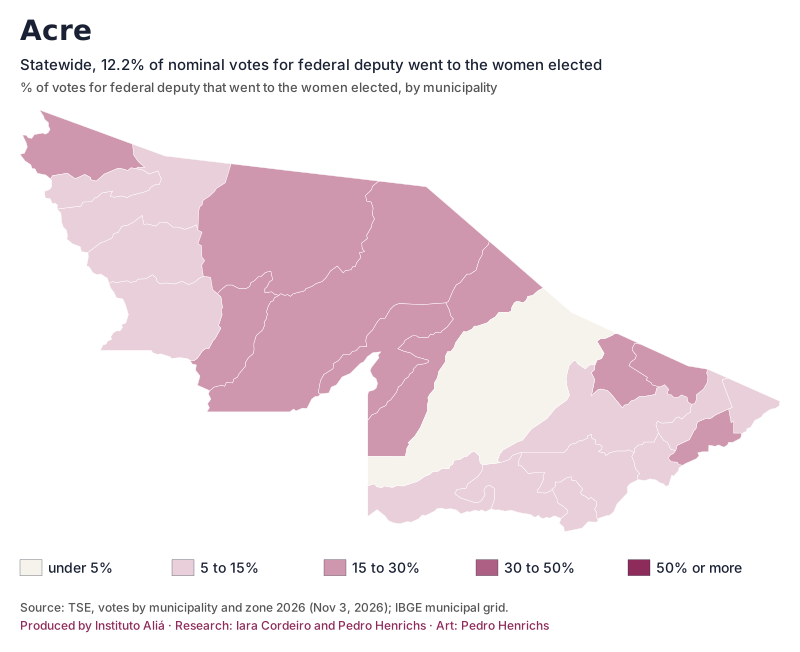
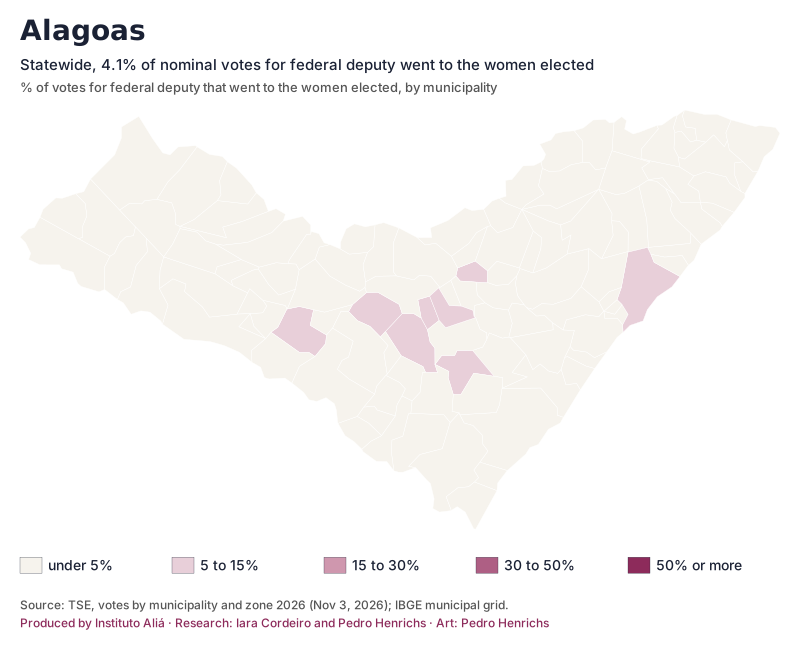
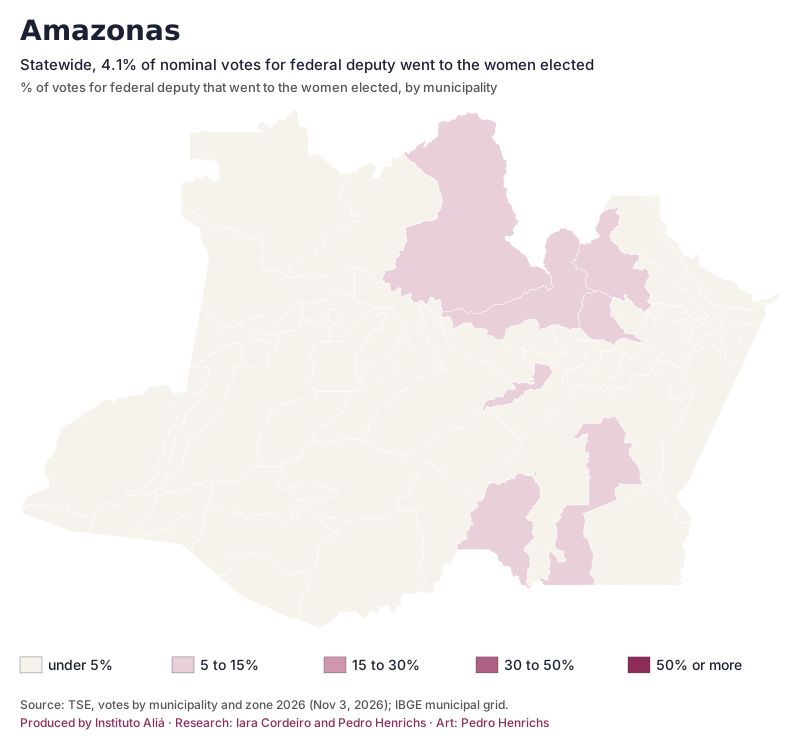
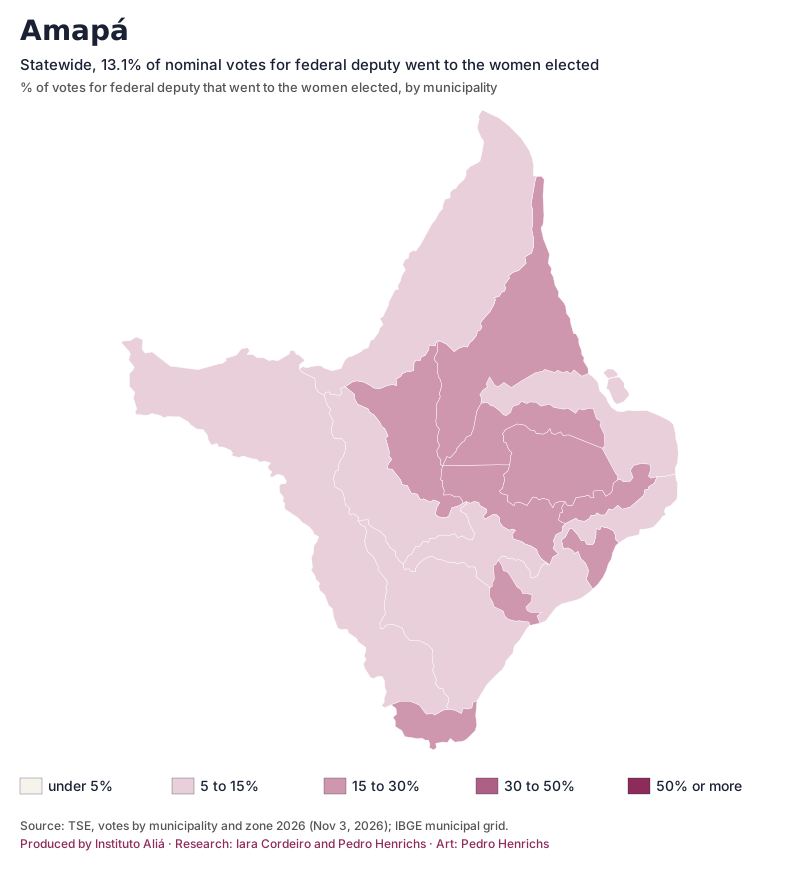
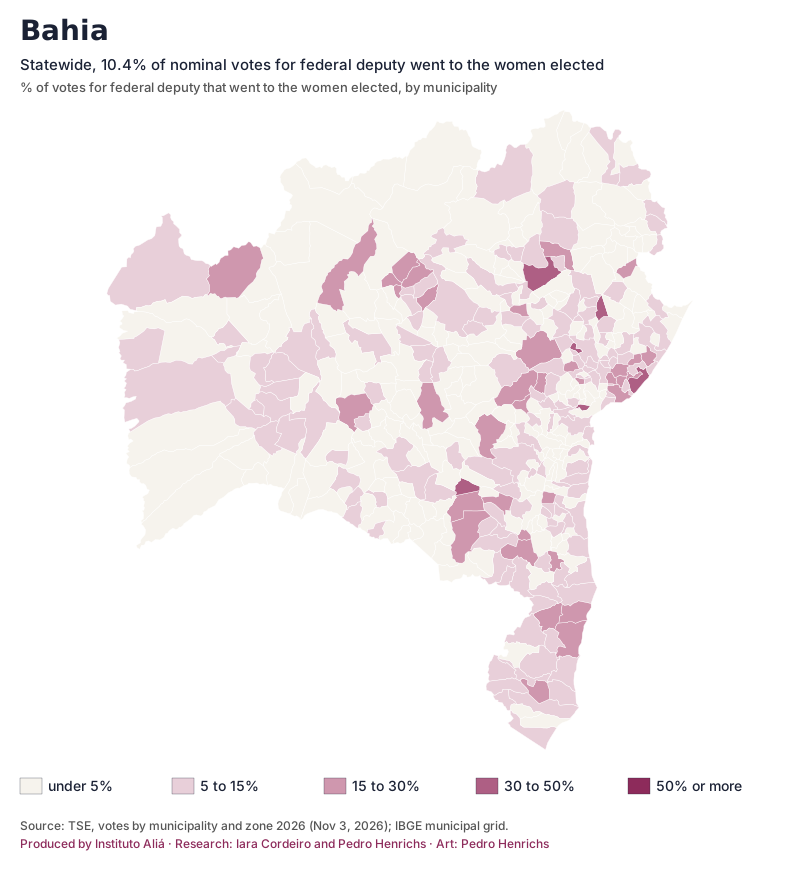
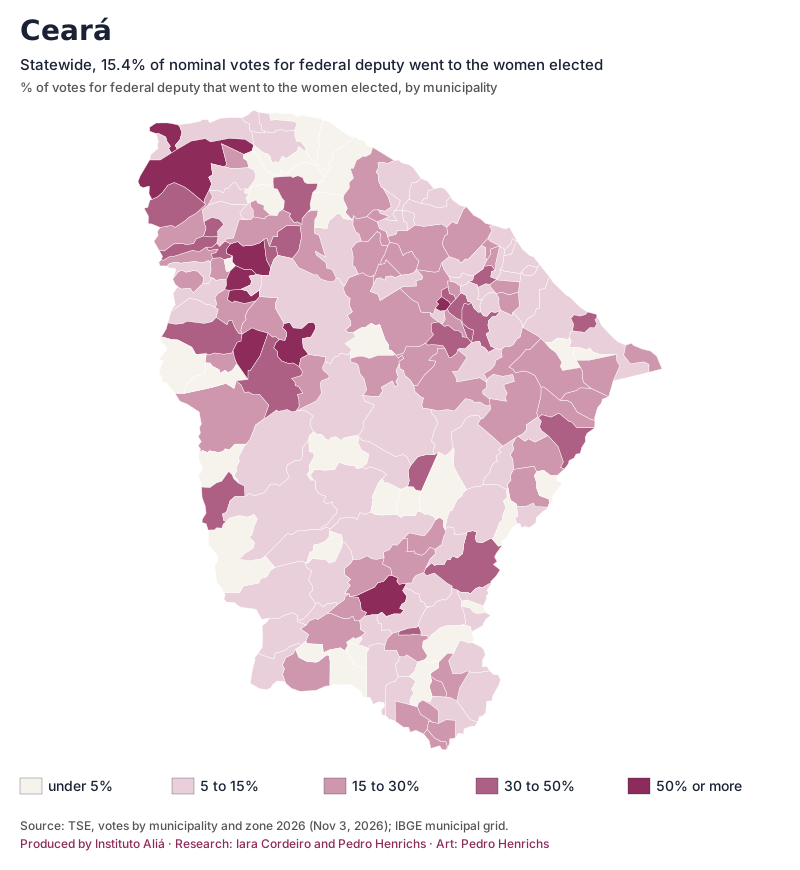
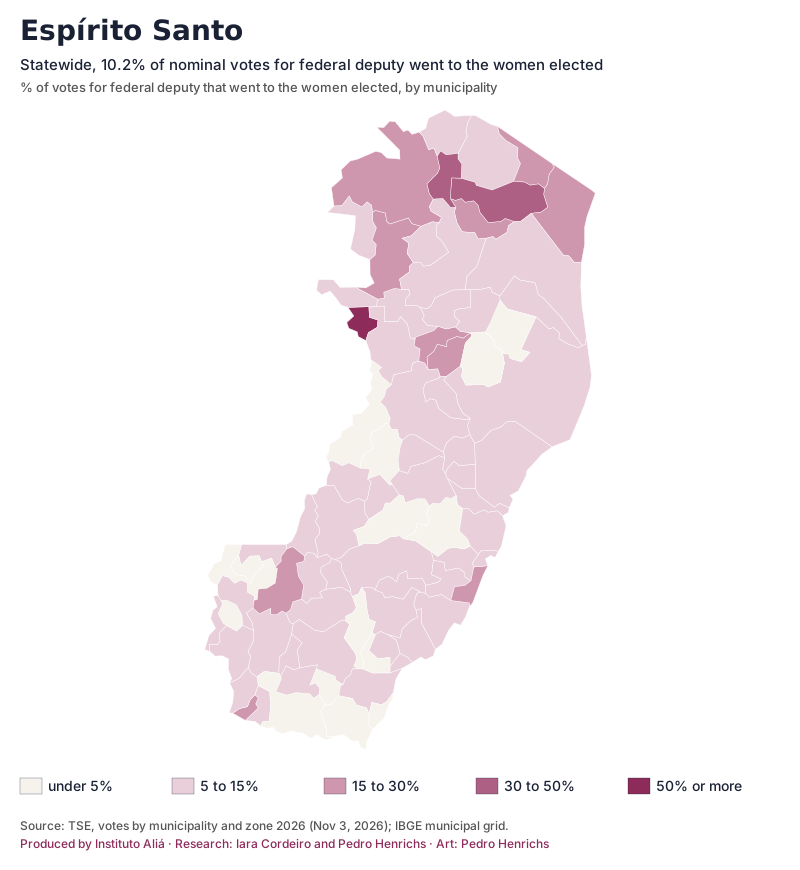
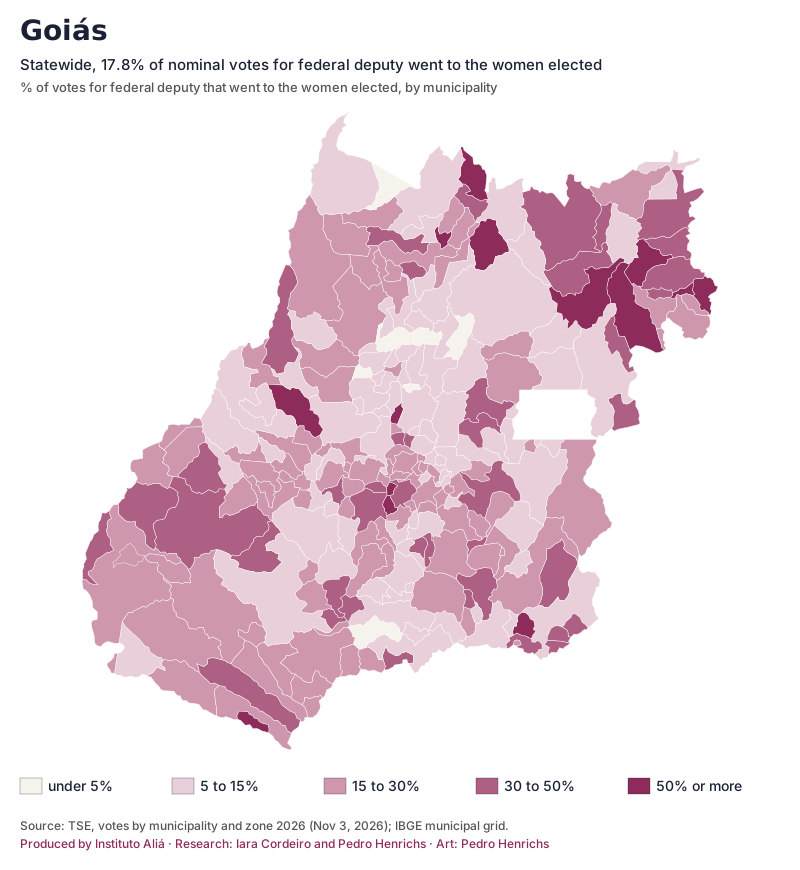
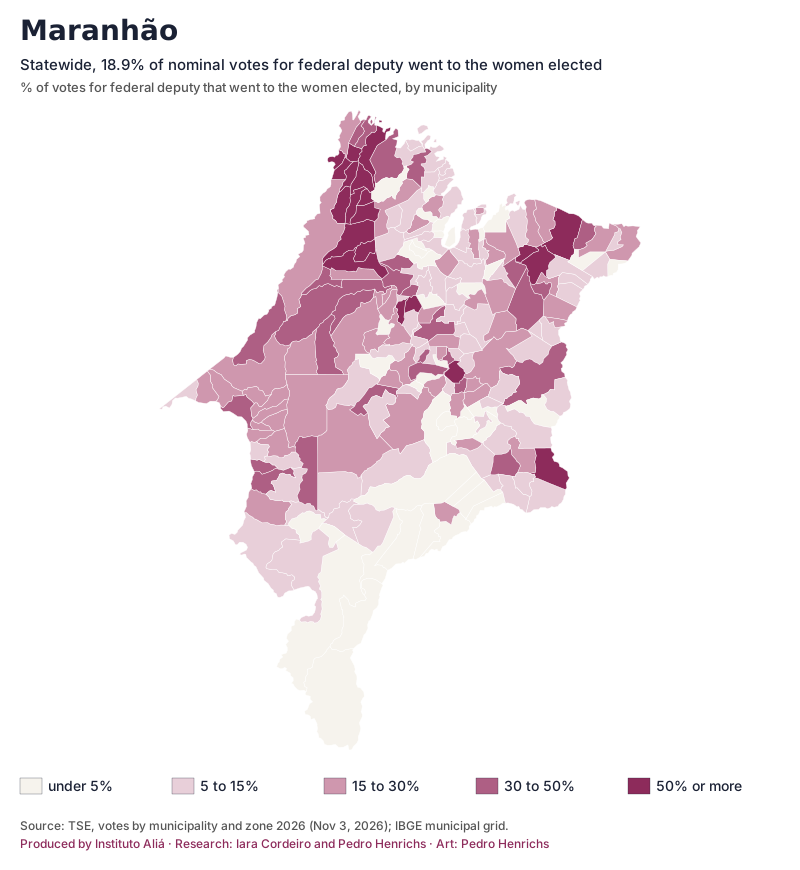
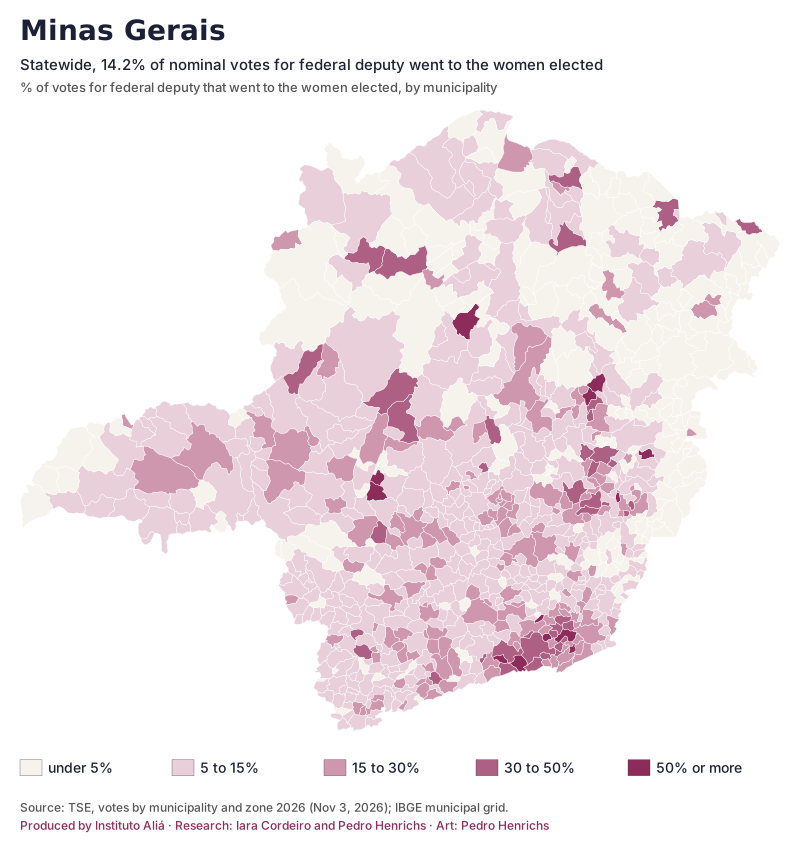
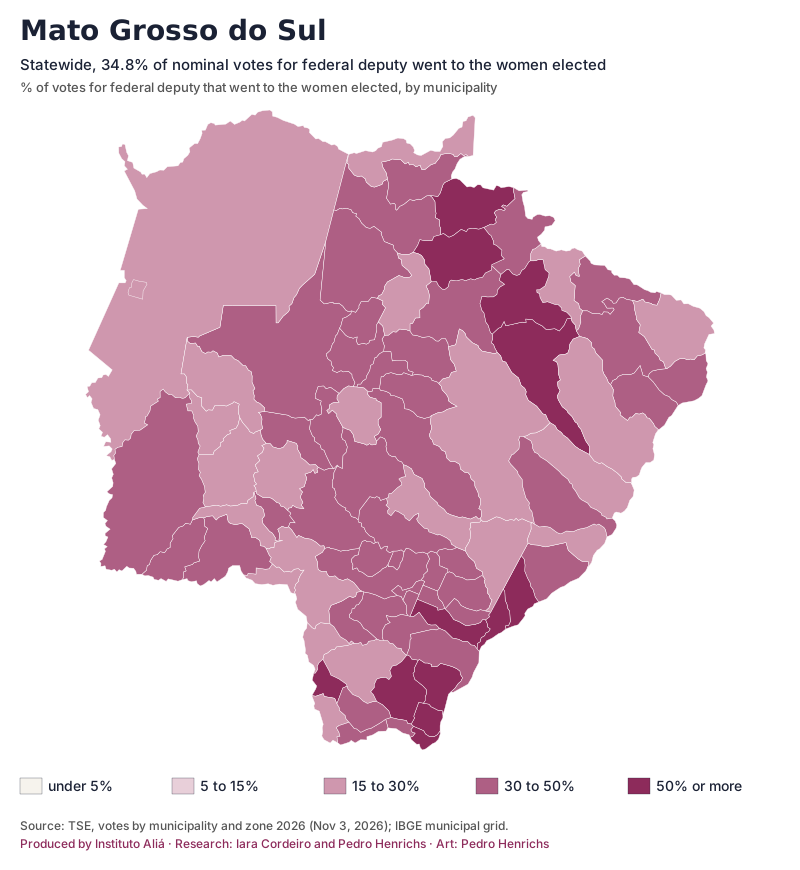
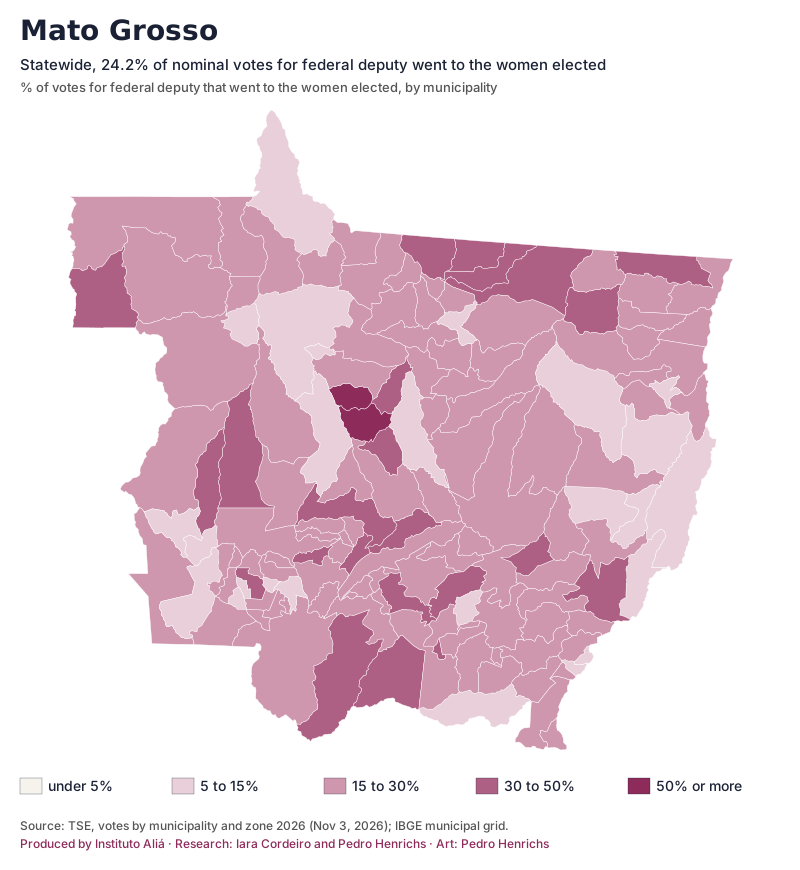
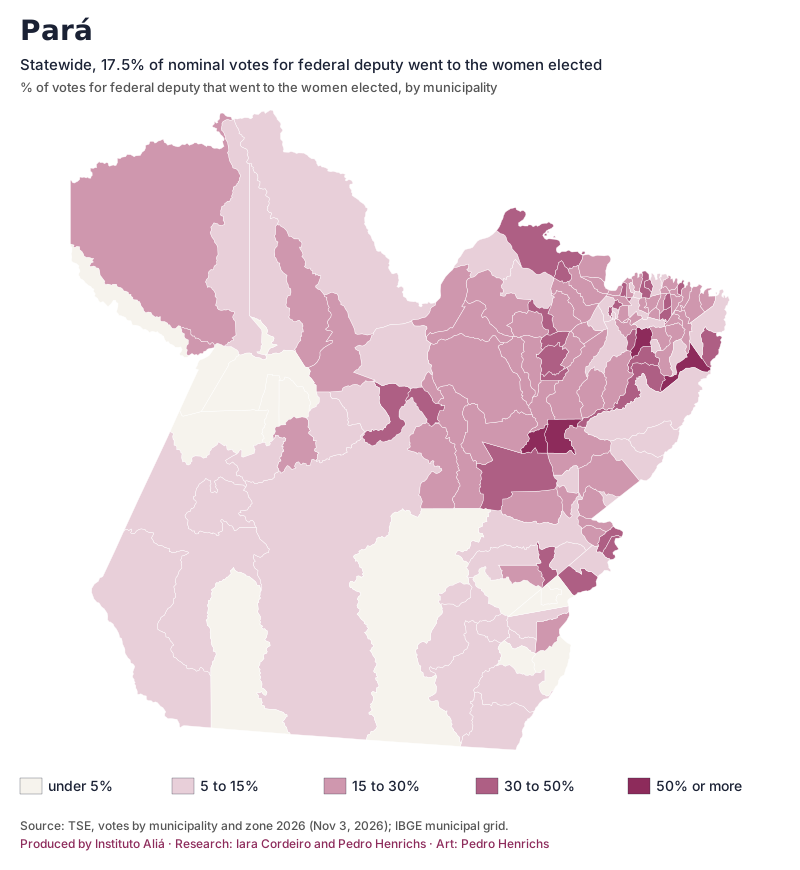
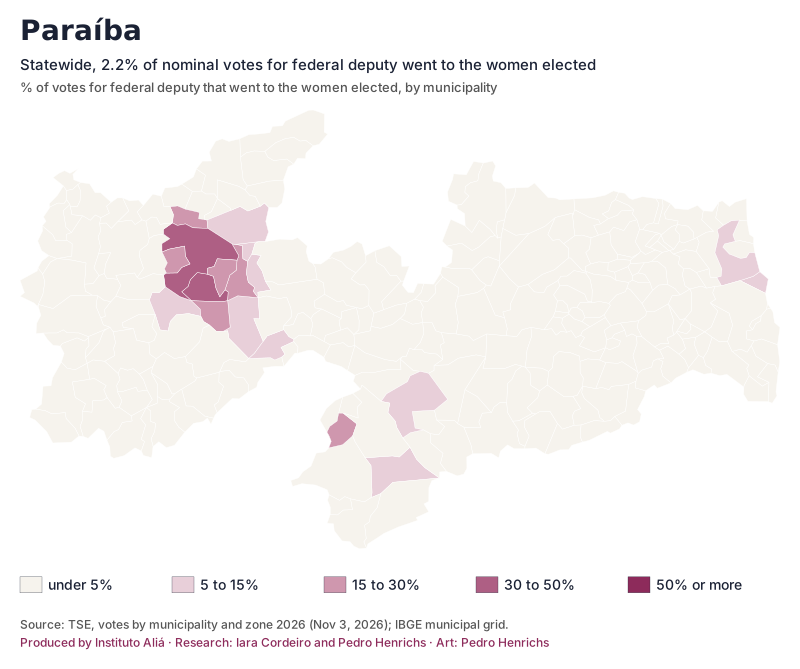
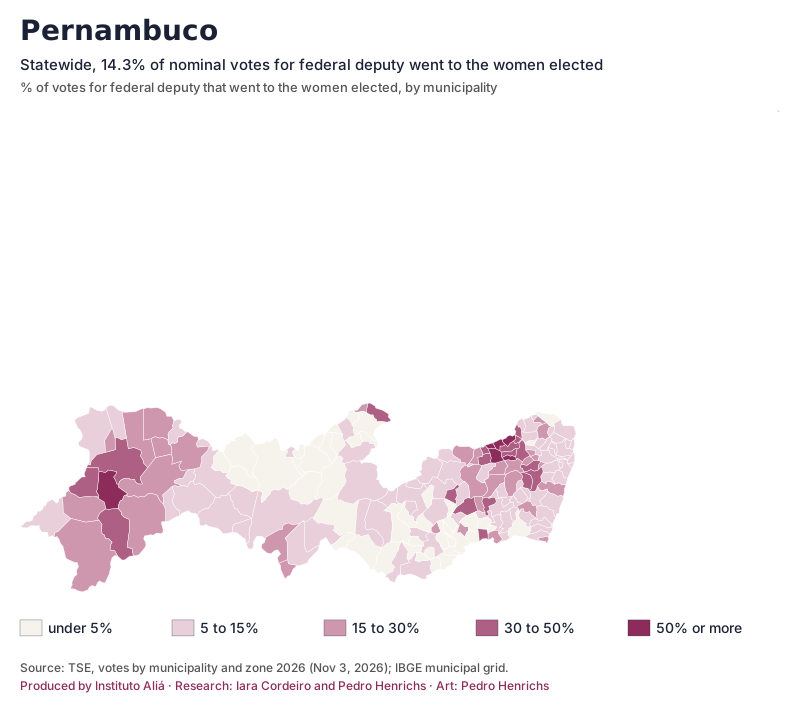
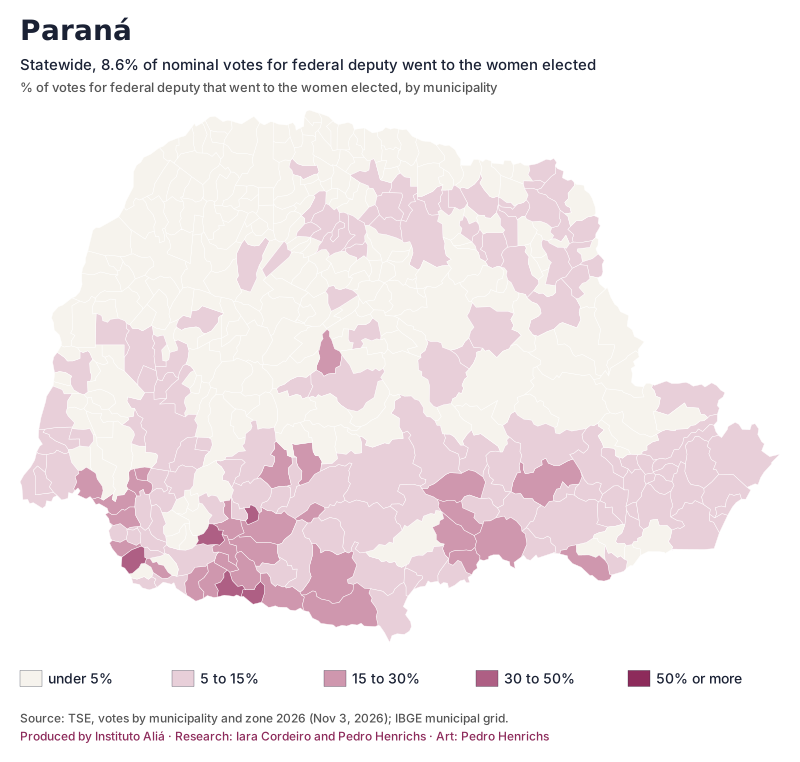
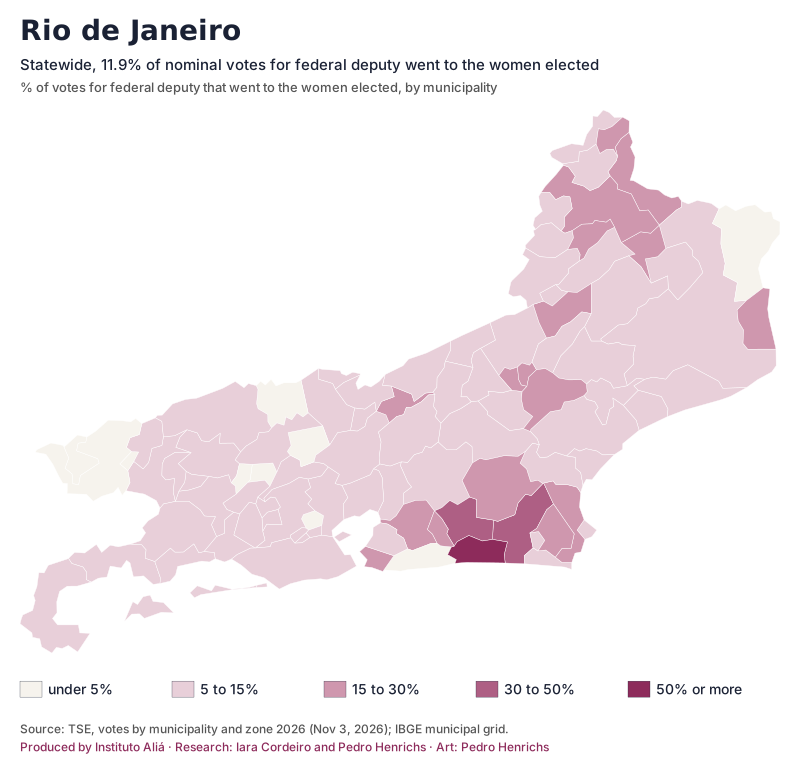
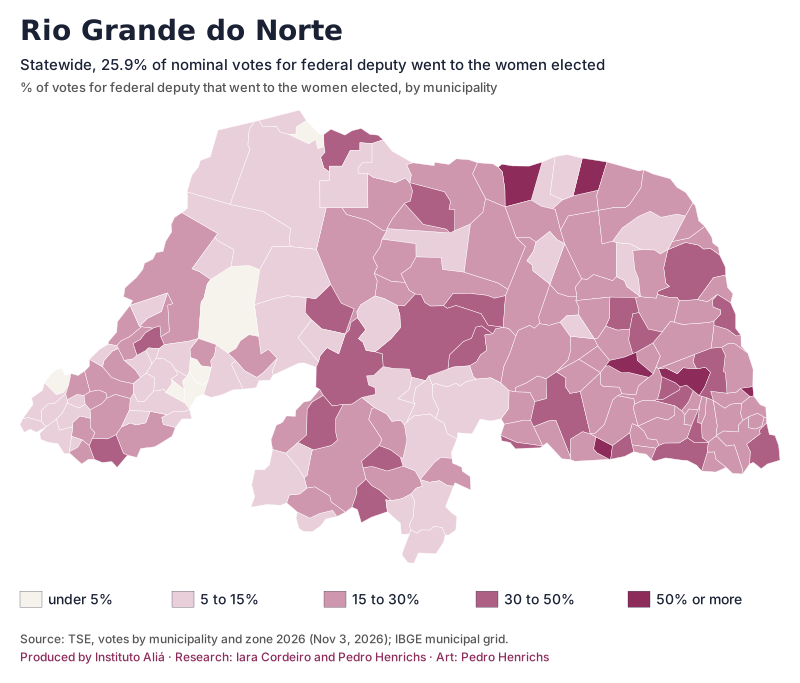
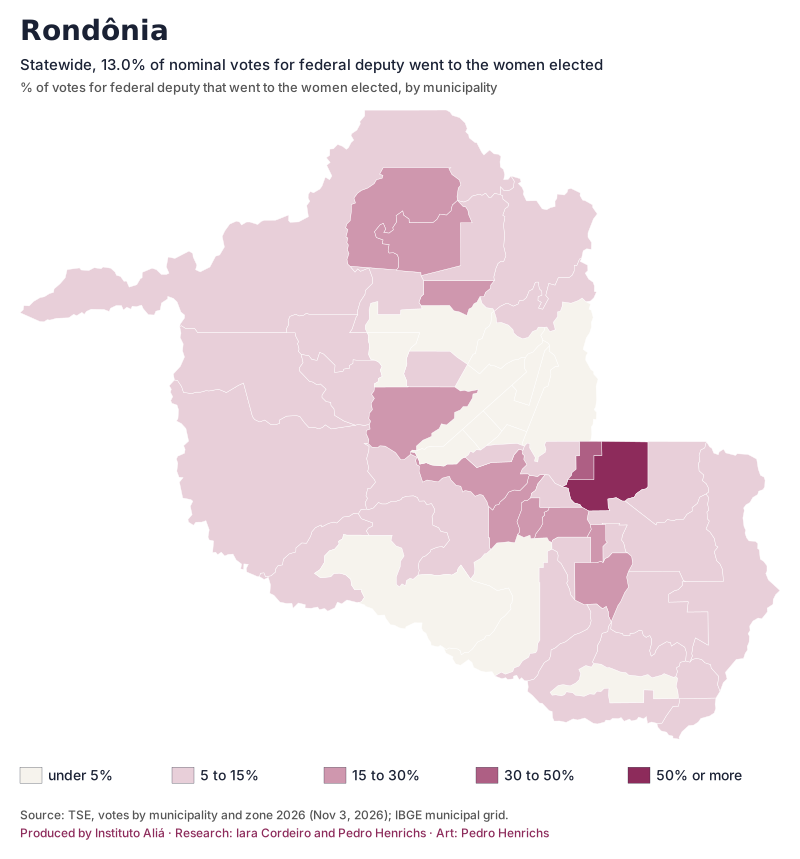
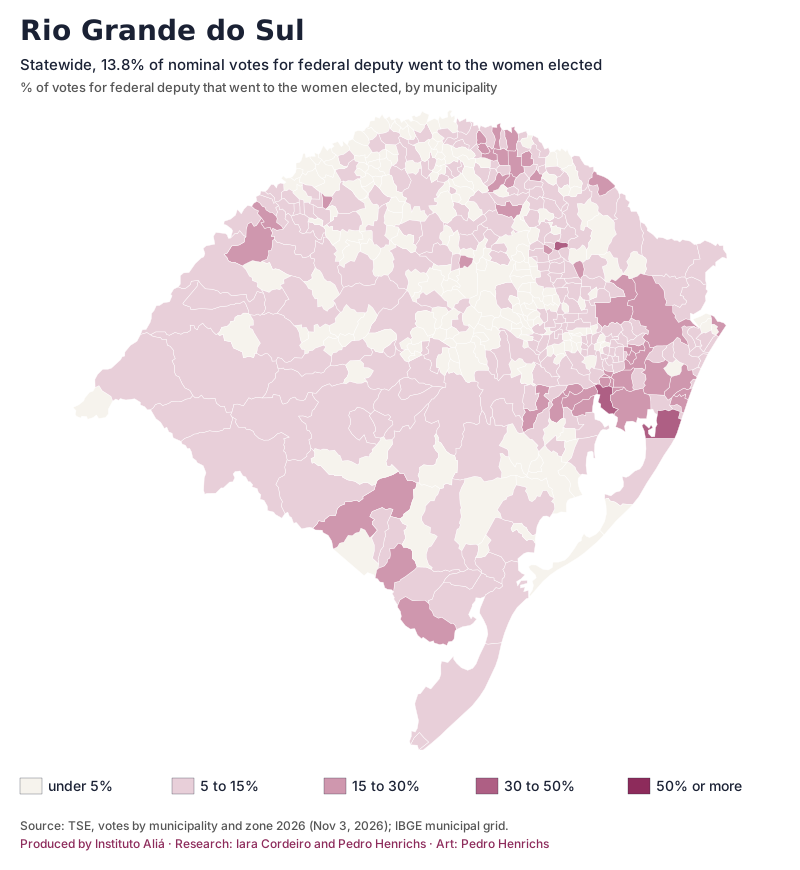
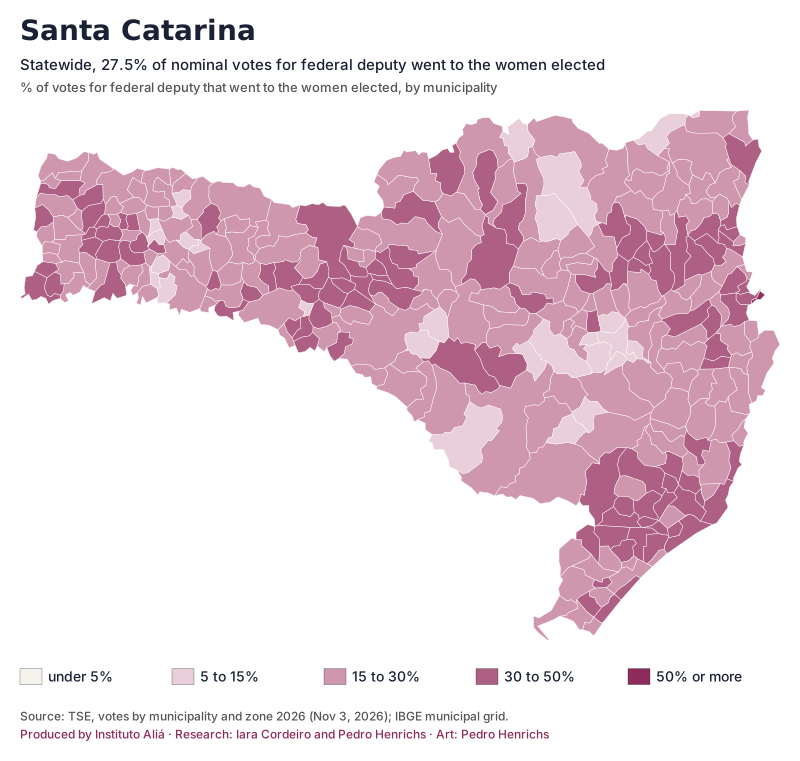
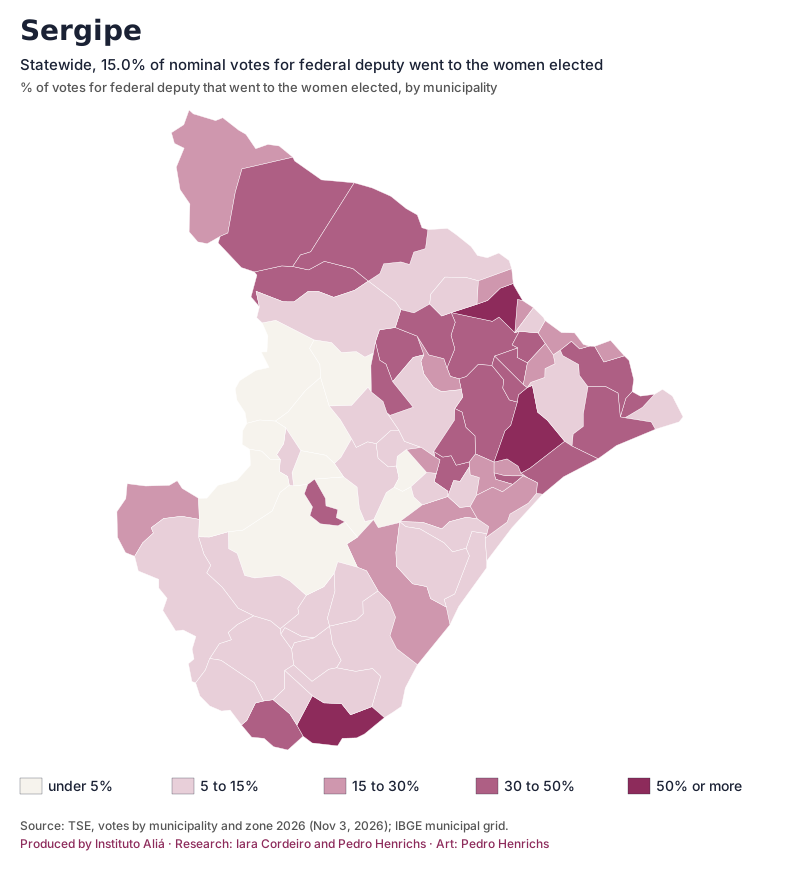
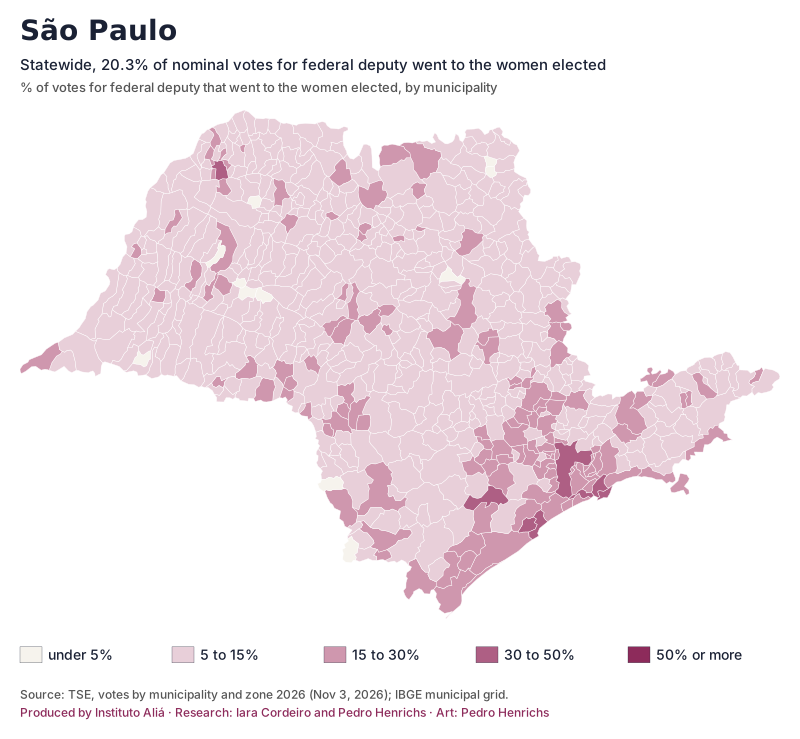
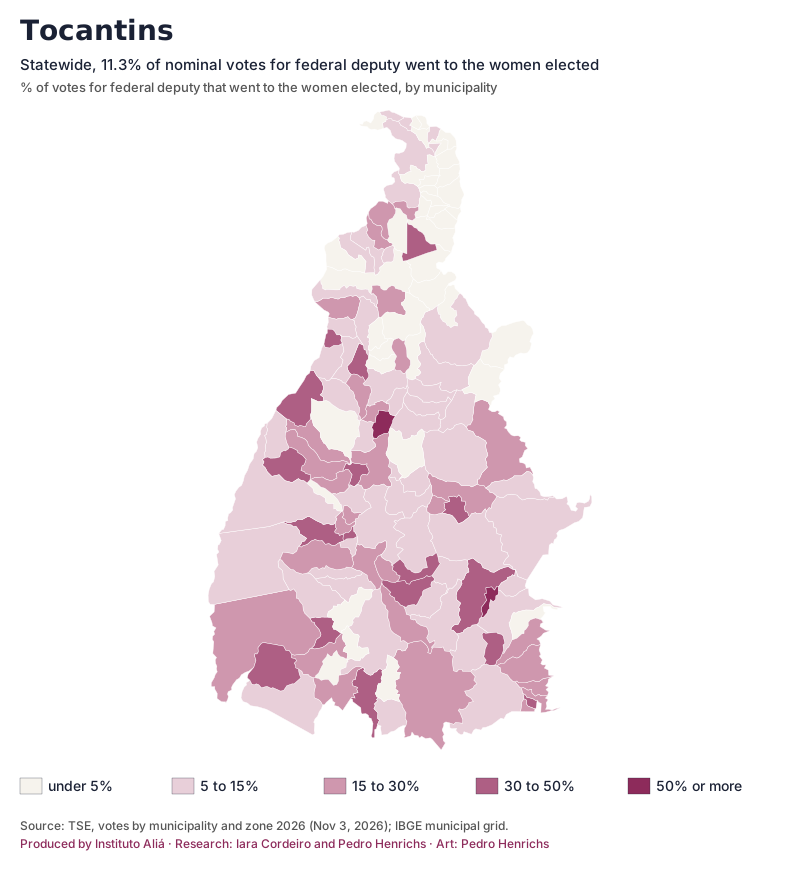
16. How women deputies voted when there was conflict
Roll-call votes of the 2023 to 2026 legislature. Laws on violence pass by voice vote; there is only a tally where there is a dispute.
| Vote | Left | Center | Right |
|---|---|---|---|
| Urgency for the National Care Policy (Sep 10, 2024; plenary 339 to 39) | 32 yes | 11 yes, 3 no | 12 yes, 10 no |
| Urgency for criminalizing misogyny (Jul 1, 2026; 293 to 158) | 34 yes | 12 yes | 8 yes, 22 no |
| PEC (proposed constitutional amendment) granting amnesty to parties that failed to comply with quotas (Jul 11, 2024, second round; 338 to 83) | 10 against, 21 in favor | 2 against, 15 in favor | 12 against, 18 in favor |
- On the quota amnesty, 54 of the 78 women deputies present voted with the parties.
- Bridges in the center and on the right, reelected in 2026: Socorro Neri (PP-AC), Iza Arruda (MDB-PE), Renilce Nicodemos (MDB-PA), Fernanda Pessoa (PSD-CE) and Delegada Katarina (PSD-SE) voted with the agenda on all three; Amanda Gentil (PP-MA), Silvye Alves (UNIÃO-GO) and Flávia Morais (MDB-GO) on the two in which they voted.
Source: Chamber, open data, votes 2457424-6, 2636281-8 and 2352476-168.
17. Legislative output
- 68 laws on the women's agenda signed into law from February 2023 to October 2026; 37 deal with violence.
- 36 of 42 plenary rapporteurships went to women: 15 from the left, 12 from the right and 9 from the center.
- 36 laws have a woman deputy as lead author; 8 of them are by Laura Carneiro.
- The top rapporteur is leaving: Laura Carneiro (PSD-RJ), with 15 laws as rapporteur, ended up as an alternate.
- Most prolific proposers among the reelected: Silvye Alves (UNIÃO-GO), Sâmia Bomfim (PSOL-SP) and Denise Pessôa (PT-RS), with 35 bills on the agenda each. Soraya Santos (PL-RJ) was the plenary rapporteur for the protocol for rape cases (Law 15,516/2026) and the registry of people convicted of sexual crimes (Law 15,035/2024).
The other side of output: bills against women's rights
- The Elas no Congresso platform (AzMina) classifies gender-related bills as favorable or unfavorable to women's rights: 463 unfavorable in the 2023 to 2026 legislature (up to March 2026), against 240 in the previous one. The most targeted topics: gender-based violence (142), sexual and reproductive rights (90) and LGBTQIAPN+ people (35).
- Among bills authored by women, 17% were unfavorable; among those authored by men, 27%. In PL, 255 unfavorable and 241 favorable (51% unfavorable); in PT, 22 and 378.
- In the 2019 to 2022 legislature, CFEMEA's Radar Feminista counted 397 bills on women's rights, 357 favorable and 40 against (17 of them on abortion); 153 were authored by women and 242 by men (CFEMEA, "Mulheres e Resistência no Congresso Nacional 2019-2022", 2023, pp. 15 to 25).
The Elas no Congresso classification is done by artificial intelligence with human validation; the party figures add up only what the platform publishes.
18. Women's bodies in Congress
Chamber
- Coordenadoria dos Direitos da Mulher (Women's Rights Coordination Office): Jack Rocha (PT-ES), with Laura Carneiro (PSD-RJ), Talíria Petrone (PSOL-RJ) and Alice Portugal (PCdoB-BA).
- Procuradoria da Mulher (Women's Ombudsman Office): Coronel Fernanda (PL-MT), with Carla Dickson (PL-RN), Maria Rosas (REPUBLICANOS-SP) and Flávia Morais (MDB-GO).
- Observatório Nacional da Mulher na Política (National Observatory of Women in Politics): Iza Arruda (MDB-PE), with Socorro Neri (PP-AC), Tabata Amaral (PSB-SP) and Greyce Elias (PL-MG).
- Comissão de Defesa dos Direitos da Mulher (Committee for the Defense of Women's Rights): Erika Hilton (PSOL-SP).
- The Coordination Office, the Ombudsman Office and the Observatory together make up the Chamber's Secretaria da Mulher (Women's Secretariat).
- 12 of the 14 office holders were reelected; Laura Carneiro and Carla Dickson are out.
- Calendar: Committee leadership in March 2027; Coordination Office, Ombudsman Office and Observatory in May 2027.
Senate and Congress
- Senate Bancada Feminina (Women's Caucus): led by Professora Dorinha (UNIÃO-TO), who remains a senator after losing the race for governor of Tocantins.
- Procuradoria Especial da Mulher (Special Women's Ombudsman Office): Augusta Brito (PT-CE), appointed in September 2025, left office in April 2026. Current holder to be confirmed.
- Comissão Mista de Combate à Violência contra a Mulher (Joint Committee to Combat Violence against Women): chaired by deputy Luizianne Lins (REDE-CE), who joins the Senate in 2027.
- The Senate has no standing committee of its own on women; the topic goes through the CDH (Comissão de Direitos Humanos, Human Rights Committee) and the joint committee.
19. Committees, rapporteurships and leadership in the Chamber
Being elected is the first step. Inside the Chamber, power runs through the Board (Mesa Diretora), the chairs of the standing committees, rapporteurships and party leadership, which forms the College of Leaders and negotiates the agenda. This chapter uses the series of standing committee chairs and vice-chairs from the Chamber's Standing Committees Coordination Office (COMPI/SGM), organized by Iara Cordeiro, and the Chamber's open data.
Standing committee chairs and vice-chairs, by legislature
| Legislature | Chairs held by women | Vice-chairs held by women | Women elected to the legislature |
|---|---|---|---|
| 48th (1989 and 1990) | 2 of 30 (6.7%) | 4 of 88 (4.5%) | 5.3% |
| 49th (1991 to 1994) | 4 of 54 (7.4%) | 13 of 164 (7.9%) | 5.8% |
| 50th (1995 to 1998) | 0 of 65 | 12 of 199 (6.0%) | 6.2% |
| 51st (1999 to 2002) | 6 of 72 (8.3%) | 23 of 206 (11.2%) | 5.6% |
| 52nd (2003 to 2006) | 7 of 82 (8.5%) | 27 of 244 (11.1%) | 8.2% |
| 53rd (2007 to 2010) | 10 of 83 (12.0%) | 29 of 244 (11.9%) | 8.8% |
| 54th (2011 to 2014) | 5 of 87 (5.7%) | 25 of 243 (10.3%) | 8.8% |
| 55th (2015 to 2018) | 16 of 99 (16.2%) | 44 of 256 (17.2%) | 9.9% |
| 56th (2019) | 4 of 25 (16.0%) | 16 of 67 (23.9%) | 15.0% |
| 57th (2026) | at least 7 of 30 (23.3%) | 17.7% |
Each row adds up annual terms: a committee chaired by a woman for two years counts twice. Vice-chairs add up the 1st, 2nd and 3rd.
- The first woman chair in the series is Irma Passoni, at the Public Service Committee, in 1989. Between 1995 and 1998, no standing committee was chaired by a woman.
- In seven of the nine legislatures, women's share of chairs was above their share of deputies; it was below in the 50th and the 54th.
- The committees most often chaired by women were Social Security and Family; Amazon, National Integration and Regional Development; Human Rights and Minorities; Education and Culture; and Defense of Women's Rights (three times each).
- From 2020 to 2025 the series has a gap: the COMPI spreadsheet runs to 2019 (updated on Feb 5, 2021), and the Chamber's API shows committees with no chair recorded in those years. The series will be completed with COMPI.
Chairs of the Chamber's standing committees (2026)
As of Feb 4, 2026, 22 of the 30 standing committees had an elected chair, and 6 were women. With the Committee for the Defense of Women's Rights, chaired by Erika Hilton (PSOL-SP), there are at least 7 of 30.
| Committee | Chair |
|---|---|
| Public Administration and Service | Delegada Ione (AVANTE-MG) |
| Amazon | Juliana Cardoso (PT-SP) |
| Communication | Maria Rosas (REPUBLICANOS-SP) |
| Culture | Carol Dartora (PT-PR) |
| Defense of Women's Rights | Erika Hilton (PSOL-SP) |
| Human Rights | Alice Portugal (PCdoB-BA) |
| Tourism | Daniela Reinehr (PL-SC) |
The 2027 chairs will be chosen in March. Source: Congresso em Foco (Feb 5, 2026).
The Board (Mesa Diretora)
No woman has ever presided over the Chamber. According to the open data, since 1999 the following women have held full seats on the Board: Rose de Freitas (1st vice-president, 2011), Mara Gabrilli (3rd secretary, 2015), Mariana Carvalho (2nd secretary, 2017), Soraya Santos (1st secretary, 2019), Marília Arraes, Rose Modesto and Rosangela Gomes (2nd, 3rd and 4th secretaries, 2021), Geovania de Sá (3rd secretary, 2022) and Delegada Katarina (3rd secretary, 2025). The Board elected in 2023 does not appear in the open data.
Floor rapporteurships, 2023 to 2026
Of the 1,524 bills voted on the floor (excluding motions, appeals and messages), 1,029 had a floor rapporteur, for a total of 1,065 rapporteurships. Women held 353 (33.1%), close to twice their share of the Chamber in this legislature (about 18%). There were 87 women and 253 men rapporteurs.
| Year | Rapporteurships held by women | Total | % |
|---|---|---|---|
| 2023 | 91 | 219 | 41.6% |
| 2024 | 112 | 287 | 39.0% |
| 2025 | 76 | 329 | 23.1% |
| 2026 | 74 | 230 | 32.2% |
- Most rapporteurships: Meire Serafim (22), Duda Salabert (15), Socorro Neri (14), Flávia Morais (12) and Yandra Moura (11).
- By the women rapporteurs' party: PT 57, União 55 and PL 47.
- Counted from the floor entries in the bills' procedural records (appointment of rapporteur and opinion delivered on the floor); each bill and rapporteur pair counts once.
Leadership
In 2025, three women led party caucuses or blocs: Talíria Petrone (PSOL-RJ, in the PSOL-Rede federation), Adriana Ventura (NOVO-SP) and Caroline de Toni (PL-SC, in the Minority). In 2024, PSOL was led by Erika Hilton (SP). In the February 2026 changes, Talíria Petrone and Caroline de Toni were replaced by Tarcísio Motta and Gustavo Gayer, and Jandira Feghali (PCdoB-RJ) began representing PCdoB within the federation with PT, a role that, for official purposes, is equivalent to deputy leader. NOVO is not among the 2026 changes reported.
Sources: Chamber COMPI/SGM (spreadsheet of standing committee chairs and vice-chairs, organized by Iara Cordeiro); Chamber open data (Board, votes and procedural records, accessed Nov 5, 2026); Congresso em Foco (Feb 3, 2025, Feb 5, 2026 and Feb 21, 2026); Instituto Aliá's calculation.
20. Gender-based political violence
What is known after the election (as of Nov 3, 2026, there is no official total for the entire election period nor a gender breakdown for the runoff; the TSE has not published a figure newer than September's)
- First-round campaign (Aug 16 to Oct 4, 2026): 134 episodes of political violence, one every nine hours (121 in the first round of 2022). Women were the victims in 70 (52.2%). Of the 102 episodes against candidacies, 60 targeted women (58.8%), although they made up 34.85% of candidacies. Online, 34 of 42 (81%). No perpetrator had been punished (Terra de Direitos and Justiça Global, Oct 7, 2026).
- Among victims who ran in 2026: of the women attacked from October 2024 to August 2026, 139 ran and 62 (45%) were elected (same source).
- Disque 100 (human rights hotline): 90 reports of political violence from 1 to 25 October, compared with 20 in the whole month of September; 19 on the day of the first round and 8 on the day of the second. Adding other channels, 189 reports in September and October, with no gender breakdown (Ministry of Human Rights, via Agência Gov, Oct 30, 2026).
- Ligue 180 (women's hotline): 1,564 reports of political violence against women from January to August 2026; 53% of the victims Black or pardo (to be confirmed in the Ministry of Women's source; via Agência Brasil, Oct 10, 2026).
- Before the election: 177 gender-based political violence cases in the Electoral Justice system in 2026 up to September, compared with 15 in 2022 (TSE, via CartaCapital, Sep 29, 2026); 354 cases of political violence from October 2024 to August 2026, only 9 with punishment (Terra de Direitos and Justiça Global, via Agência Brasil, Oct 1, 2026).
- A crime since 2021 (art. 326-B of the Electoral Code), punishable by 1 to 4 years.
- From complaint to punishment (Monitor de Violência Política de Gênero e Raça, 2nd edition, Instituto Alziras, 2025, with data from 2021 to June 2025): of 340 complaints, 245 (72%) relied on Law 14,192/2021; there were 62 criminal cases, 85% of them opened in an election year. Of the 24 rulings on the merits, 14 were convictions, generally with sentences of 1 to 2 years, and all were under appeal; no final conviction. Since ineligibility under the Lei da Ficha Limpa (Clean Record Law) depends on a collegiate decision, punishment is slow.
- The road to punishment stalls early (same Monitor): 30 of the 99 police investigations were closed; of the 62 cases, 12 ended, none with a conviction; in 12 of the 14 convictions under appeal, prison was replaced by alternative sentences, generally of 1 to 5 minimum wages; only 2 agreements suspending proceedings provided for compensation to the victim. There is no national registry of cases: the group at the Ministério Público Federal (MPF, Federal Prosecution Service) depends on official requests with no deadline.
- The series: in the 1st edition (data from 2021 to 2023, Instituto Alziras, 2024), of 175 complaints, 9 (5%) had become criminal cases, with 1 conviction. In the 2nd, the share rose to 11%, still with no final conviction.
- Who the victims and the accused are (same Monitor): of the 69 victims, 55% are city councilors, 3 federal deputies and 1 a senator; 65% white and 33% Black. Of the 73 accused, 86% are men and 60% hold public office (40% are city councilors); among the accused with a party, PL leads (11%), followed by União and MDB (7% each). 63% of the cases occurred during the term of office and 40% in a digital environment, almost all on social media (Instagram 40%, WhatsApp 27%, Facebook 23%). By region: Southeast 37%, South 24%, Northeast 21%, Center-West 10% and North 8%, the latter with only 2 of its 7 state Public Prosecutor's Offices responding. The figures are for the mapped cases, not the total number of cases.
- In the Executive too: 43% of women secretaries of states and state capitals report gender-based violence in office, and the most cited aggressors are colleagues (65%) and party members (41%) (Instituto Alziras and partners, Censo das Secretárias, Nota Técnica 2, 2024, with 230 responses).
- First convictions (NT 12 of the Chamber's Observatory, Laura Petrucci, Aug 10, 2026): the first conviction under art. 326-B came from the Tribunal Regional Eleitoral (TRE, Regional Electoral Court) of Rio de Janeiro in May 2024; in December 2025, the TRE of Espírito Santo imposed the second 8-year ineligibility. The note explains that the crime does not allow a non-prosecution agreement.
- What women candidates report (DataSenado and Observatório da Mulher contra a Violência, Senate, survey "Mulheres na Política", 2022, with 2,850 candidates from 2018 and 2020): 32% of women candidates said they had been discriminated against in the political environment for being women; 22% were disparaged because of their gender (8% of men); 38% ran at the party's initiative (19% of men); 63% are mainly responsible for household chores (34% of men). The series of cases in the Electoral Justice system (gender-based political violence, January to August of each year; TSE, via CNN Brasil, Sep 23, 2026)
| Year | 2019 | 2020 | 2021 | 2022 | 2023 | 2024 | 2025 | 2026 |
|---|---|---|---|---|---|---|---|---|
| Cases | 2 | 0 | 0 | 6 | 13 | 31 | 68 | 149 |
- From 2024 to 2026, a 380% rise. The TSE dashboard, launched on Sep 22, 2026 with the MPF, counts 392 cases, 219 still pending (Correio Braziliense, Sep 22, 2026). The rise mixes more cases with more reporting: the law dates from 2021, and reporting has become easier.
Online (MonitorA, InternetLab, AzMina and Núcleo)
- 2020, municipal elections: 175 candidacies monitored; in the first round, 11% of the tweets mentioning women candidates were aggressive. Among the insults, 42.5% were moral, 27.1% fatphobic and 18.4% discrediting (2020 report, pp. 27 to 30).
- 2022, general elections: 174 women candidates and 24 men as a control group, 1.7 million tweets; MonitorA identified 12 cases taken to court in the period, and the MPF reported 62 pending (2022 report, pp. 10 and 11).
- 2024, municipal elections: in the state capitals' debates, women were 44.4% of the candidacies and received 51.1% of the offensive comments; in Belo Horizonte, 91.7%. In the last round of debates, 68.2% of the offensive comments were against women and 22.1% of them were violent (against 6.3% of those aimed at men) (2024 report, pp. 26 and 43).
- 2026: MonitorA is following more than 200 women candidates, at least half of them Black, for the first time including TikTok; the results have not yet been released.
Against Black women (Instituto Marielle Franco, "Regime de ameaça", 2025; 77 cases from June 2021 to July 2025, with Justiça Global and Terra de Direitos)
- 87% of the victims are Black; 71% held office, 48% were city councilors (pp. 32 and 34).
- Among the threat cases, 63.6% were rape threats and 30.9% death threats; 94% of the death threats had racist content and 63% mentioned the murder of Marielle Franco (pp. 41 and 45).
- 72% arrived by direct message, mainly e-mail (41%) and Instagram (27%) (pp. 47 and 48). The aggressors, in general, were not identified (p. 52).
- Of the 58 Black women parliamentarians elected in 2018, 52 ran again in 2022; Áurea Carolina (PSOL-MG) did not apply for registration, according to the survey, because of political violence (Mulheres Negras Decidem, "Parlamentares Negras 2022: balanço dos mandatos", 2022, pp. 23 and 35).
- In 2020, of the 142 Black women candidates heard by the Institute, 98.5% reported more than one type of political violence and 78% online violence (2020 survey, via Brasil de Fato, Nov 6, 2020).
In election observation (Transparência Eleitoral Brasil, 2022 mission with a gender perspective, 54 cities)
- In the publicly reported cases, 85% were psychological violence, 71% took place online and 78% of the perpetrators were men (final report, 2023, pp. 16, 34 and 35). Small sample: indicative.
- When asking the Public Prosecutor's Offices for cases, the Observatory counted 94, but five offices were unable to respond because the CNMP has no classification for gender-based political violence (2022-2023 Report, pp. 55 to 59). Without a common classification, there is no way to add up the country's cases.
In the world (Inter-Parliamentary Union, surveys of parliamentarians)
| Study | Psychological violence | Sexist remarks | Online attacks | Threats of death, rape or assault | Sexual violence |
|---|---|---|---|---|---|
| World, 2016 (55 parliamentarians, 39 countries) | 81.8% | 65.5% | 41.8% | 44.4% | 21.8% |
| Europe, 2018 (81 parliamentarians, 45 countries) | 85.2% | 67.9% | 58.2% | 46.9% | 24.7% (harassment) |
| Africa, 2021 (137 parliamentarians) | 80% | 67% | 46% | 42% | 39% |
| Asia-Pacific, 2025 (85 parliamentarians) | 76% | 61% | 60% | 34% | 25% |
- In 2026, the IPU heard parliamentarians of both sexes in five countries and in a global sample: 76% of the women and 68% of the men suffered violence from the public, and 86% of the women, against 64% of the men, think violence has increased in five years ("When the public turns hostile", 2026, pp. 7 and 8). In Argentina, the only Latin American case, 82% of the women parliamentarians and 69.8% of the men parliamentarians suffered online abuse (p. 20).
- None of the IPU surveys includes Brazil. A survey of the women deputies and senators elected in 2026, with the same questionnaire, would give the country its first comparable measure.
The fear (Fórum Brasileiro de Segurança Pública and Datafolha, May 2026): 65% of women and 53.1% of men fear suffering violence because of their political choice (chapter 22).
- The counts have different methods, channels and periods and cannot be added up. Left out of the text, for lack of an official source: number of Federal Police investigations and convictions after Oct 4.
21. The agenda the new legislature inherits
| Bill or measure | Where it stands | What the new composition changes |
|---|---|---|
| Criminalization of misogyny (bill PL 896/2023) | Senate approved it in Mar/2026; urgency in the Chamber by 293 to 158; merits pending | Passes with the center; 22 of 30 right-wing women deputies voted against urgency |
| Paternity leave of up to 20 days | Signed into law on Mar 31, 2026; 10 days in 2027, 15 in 2028, 20 in 2029 | Monitor implementation |
| National Care Policy (Law 15,069/2024) | In force; depends on a plan and a budget | The dispute is over the budget |
| Reserved seats (new Electoral Code, PLP 112/2021) | Stalled in the Senate's CCJ | A more right-leaning Senate reduces the chances in 2027 |
| Amnesty for failing to comply with quotas (Constitutional Amendment 133/2024) | Promulgated in Aug/2024 | Precedent: 54 of the 78 women deputies voted in favor |
| Abortion (bill PL 1904/2024) | Urgency approved in Jun/2024; merits stalled | A more right-leaning plenary increases the chance of revival |
Four agendas, four different majorities
- Violence against women: consensus; passes by voice vote.
- Care and work: a majority is possible; the center and the fiscal cost decide.
- Political participation: blocked by parties; the women's caucus votes with the party.
- Reproductive rights: minority; a veto issue for the right.
In the 2027 Chamber, the left (124) and the center (124) add up to 248, below the 257 of an absolute majority: every victory for the agenda depends on votes from the right (265).
Who supports the agenda (CFEMEA, "Perfil Parlamentar 2023-2026 sob a ótica da agenda feminista", 2023, based on the 2022 campaigns of all 513 deputies and 81 senators)
- In the Chamber elected in 2022, about 20% formed the feminist group and more than 40% were conservatives aligned with the moral-values agenda, but supporting some of women's causes (pp. 13 and 14).
- Abortion: 36% of deputies spoke out against legal abortion and 3% in favor; 57% did not address the topic (p. 11).
- Lei Maria da Penha: 50.2% in favor; sexism as a structural problem: 26%; gender-based political violence: only 12.3% of deputies and 17.3% of senators addressed the subject in their campaigns (pp. 9 and 10).
- CFEMEA published in 2025 an analysis of the ideological groups of the 2023 to 2026 legislature; the file did not open when accessed and is not included here.
22. What the public thinks
Four surveys, from 2022 to 2026, point the same way: the majority wants more women in politics and accepts rules that guarantee the result, not just the candidacy.
Instituto Patrícia Galvão and Ipec, "Por Mais Mulheres na Política" (January 2025; 2,000 face-to-face interviews in 129 municipalities, margin of 2 points; final report: https://sfo2.digitaloceanspaces.com/assets-institucional-ipg/wp-content/uploads/2025/03/IPGalvaoIpec_PesquisaPorMaisMulheresnaPoliticaRelatorioFinal.pdf)
- 89% want more women candidates in the next elections (p. 21).
- 59% are in favor of the minimum candidacy quota and 32% against (p. 16). Among those against, 66% say that men and women should compete on equal terms.
- Among those who support the quota (1,171 people): 86% want a law guaranteeing a minimum number of elected women, 80% want punishment for parties that fail to comply with the quota and 73% think that a party fielding only men should compete for fewer seats (p. 18). Over the whole sample, the guarantee of elected women has the support of about half the population.
- 88% support gender balance in government teams.
- Only 3% say they would not vote for a woman under any circumstances; 78% would certainly vote for one and 18% might (p. 8).
- Most cited barriers: harassment and sexist attacks, inside and outside the parties (41%; 46% of women and 37% of men), lack of family and party support (31%) and balancing work and home (27% of women, 18% of men).
DataSenado, "Mulheres e Poder" (October 2022; 1,599 responses, online questionnaire)
- 62% supported reserving seats for women in Parliament (72% of women and 50% of men); among supporters, 87% wanted parity.
- 90% favored more women in the Legislature, and 80% said they did not take gender into account when voting.
Ipsos, International Women's Day 2026 (December 2025 and January 2026; about 1,000 online interviews in Brazil, margin of 3.5 points)
- 64% think things would work better with more women in positions of responsibility (29-country average: 60%).
- 56% say there will be no equality without more women leaders in business and government (60% of women and 52% of men).
Fórum Brasileiro de Segurança Pública and Datafolha (March 2026; 137 municipalities)
- About 6 in 10 Brazilians fear suffering violence because of their political choice; among women, 65%, and among men, 53.1%.
Reading: reserved seats had 62% support in the Senate survey (2022, online) and about half in the Ipec one (2025, face-to-face, asked only of those who support the quota). The candidacy quota, the rule in force, has 59%. Those who decide the change are the parties, and it was within them that the women's caucus voted with the party on the 2024 amnesty (chapter 16).
23. Likely leaders
Chamber
- Progressive coordination: Jack Rocha (PT-ES), Jandira Feghali (PCdoB-RJ), Maria do Rosário (PT-RS), Tabata Amaral (PSB-SP), Erika Hilton (PSOL-SP).
- Bridges in the center: Flávia Morais (MDB-GO), Iza Arruda (MDB-PE), Leandre (PSD-PR), Renata Abreu (PODE-SP).
- Right, bridges and veto: Soraya Santos (PL-RJ), Coronel Fernanda (PL-MT), Socorro Neri (PP-AC), Silvye Alves (UNIÃO-GO), Amanda Gentil (PP-MA); Chris Tonietto (PL-RJ) as the reference for the conservative veto.
Senate
- Marília Campos (PT-MG), the most voted among women; Luizianne Lins (REDE-CE); Carol de Toni (PL-SC); Michelle Bolsonaro (PL-DF); Marília Arraes (PDT-PE); Teresa Leitão (PT-PE); Damares Alves (REPUBLICANOS-DF); Tereza Cristina (PP-MS).
- Professora Dorinha (UNIÃO-TO) remains leader of the women's caucus; Cheila Moreira (PT-AM) arrives as alternate of Omar Aziz.
Criteria: posts in the women's bodies, terms, rapporteurships and votes in roll-call votes. It is an indication, not a prediction.
The yardstick for 2027. In the last legislature, women chaired 2 of the Chamber's 25 standing committees (8%, Women and Culture), were 10.7% of the Colégio de Líderes (College of Leaders), and their share of the Mesa (Steering Board) fell from 27.3% to 18.2% after the supplementary election of May 2022 (NT 04 of the Chamber's Observatory, revised on Sep 6, 2023). In the state Assemblies, no woman presided over the house in 2022. The election of the Steering Boards in February 2027 and the allocation of committees in March will show whether the larger caucus turns into internal power.
Glossary
- Candidacy quota: a minimum of 30% and a maximum of 70% of candidacies of each sex on the lists for deputy and city councilor (Law 9,504/1997, art. 10, §3). It does not guarantee a seat.
- Reserved seats: a minimum percentage of seats for women in Parliament. Brazil does not have it; it is in PLP 112/2021 (new Electoral Code).
- Parity: 50% of candidacies (or of seats) of each sex. Alternation: on a closed list, women and men take turns in the order (as in Mexico and Bolivia).
- Open list: voters vote for the candidate, and the party's seats go to the most voted on the list. The order is not set by the party, so the quota does not decide who gets in.
- Electoral quotient: the number of votes a party or federation needs to win a seat (valid votes divided by the number of seats in the state).
- Federation: a union of parties that acts as a single one in the elections and during the term, for at least four years (Law 14,208/2021).
- FEFC (Electoral Fund): public money for campaigns, divided among the parties. Party Fund: public money for the functioning of parties, of which 5% must go to programs for women.
- Double-counted vote: from 2022 to 2030, votes cast for women and for Black people for the Chamber count twice in the distribution of the funds among parties (Constitutional Amendment 111/2021).
- DRAP: the application to register the party's list; if the list fails to meet the quota, it can be rejected in full.
- Sham candidacy (laranja): a woman candidate registered only to meet the quota, with no real campaign; the fraud can annul the entire list (TSE Súmula 73, 2024).
- Political violence against women: harassing, intimidating, humiliating, persecuting or threatening a woman candidate or officeholder to prevent or hinder her campaign or term, out of contempt for her condition as a woman, her color, race or ethnicity; a crime since 2021 (art. 326-B of the Electoral Code, punishable by 1 to 4 years).
- Alternate: the person who takes the seat if the holder leaves. In the Senate, each seat has a 1st and 2nd alternate on the ticket.
- IPU (Inter-Parliamentary Union): the organization of the world's parliaments, which publishes the monthly ranking of women in parliaments.
- Black women: Black and pardo women, by the IBGE classification adopted by the TSE.
Method and sources
- History of the vote: Marques, Teresa Cristina de Novaes, "O voto feminino no Brasil" (Edições Câmara); Constitutions of 1824 (art. 46), 1891 (art. 70) and 1934 (art. 109).
- Quota fraud: NEPEM/UFMG, Technical Note 5, "Cotas e fraude eleitoral nos Tribunais Brasileiros: a análise do caso de Minas Gerais (2016-2025)" (Sep 4, 2026).
- Candidacies and results 2026: TSE, candidacy query and supplementary query, data generated on Nov 3, 2026; "elected" = status ELEITO, ELEITO POR QP or ELEITO POR MÉDIA in the first round (and in the second for governor); "made it to the ballot" = tally status DEFERIDO, DEFERIDO COM RECURSO, INDEFERIDO COM RECURSO or PENDENTE.
- Color or race, age, education: self-declaration at registration; age on Feb 1, 2027; Black women = Black and pardo.
- Electoral fund: TSE, 2026 candidate campaign finance reports (revenues), data of Nov 3, 2026; FEFC = source "Fundo Especial" with origin "Recursos de partido político"; men's tickets with a woman vice or alternate identified in the registration.
- Votes by municipality: TSE, 2026 votes by municipality and electoral zone, data of Nov 3, 2026.
- Senate: Senate open data (sitting senators; terms and alternates), accessed on Nov 3, 2026.
- 2010 to 2022 series, roll-call votes, legislative output, women's bodies, political violence and agenda: survey of Oct 7, 2026, with the sources given in each chapter.
- Political camps: assigned by party label at the election. Party is not a vote: it is an approximation.
- Chance by sex and race, previous office, running again, quota by list and transfer date: TSE, candidacy data and campaign finance reports; Instituto Aliá's calculation. In 2022, "made it to the ballot" = candidacy APTA (eligible). Previous office: person linked by CPF (or voter registration number) to those elected in 2022 and 2024 and to the senators elected in 2018; the highest-weight category when there is more than one. Transfer date: date of the declared revenue (Fundo Especial originating from party resources). The 3 types of report (final, partial, financial report) are not double-counted for the same candidacy.
- Source of the counts: the TSE (open data) is the source of all counts of candidacies and elected women. When a note from the Chamber's Observatory uses a different total (91 women deputies in 2022, the figure announced at the time), the comparison says so.
- Comparative studies: Observatório Nacional da Mulher na Política (Secretaria da Mulher of the Câmara), Technical Notes of the main collection 03 (2022), 04 (2023), 06 (2024), 11 (2026) and 12 (2026), and of the partnership collection 03 (UnB, 2022), 04 (UnB, 2023), 06 (UnB, UFMG and USP, 2024), 07 (UERJ, UFPa and Câmara, 2024) and 11 (UFRGS, 2026); De Olho nas Urnas, report 2 (UFG, 2024); DataSenado and Observatório da Mulher contra a Violência (Senado), "Mulheres na Política" and "Mulheres e Poder" (2022); Instituto Alziras, Monitor de Violência Política de Gênero e Raça, 1st edition (2024) and 2nd edition (2025), "Desigualdades de Gênero e Raça na Política Brasileira" (with Oxfam, 2022), "As Prefeitas Brasileiras e os Partidos Políticos" (2020), Censo das Secretárias, NT 2 (2024), and the Convergências series on parity in Mexico, Bolivia and Chile (2022). Available on the websites of the observatories of the Câmara and the Senado, of the MPF and of Instituto Alziras.
- Scripts and data: Python routines on TSE, Chamber and Senate open data; available from Instituto Aliá on request.
- Series from 2010 to 2026 (general elections) and from 2012 to 2024 (municipal elections), Senate alternates, majoritarian tickets and Presidency: TSE, candidacy query for each election (data available on Nov 3, 2026). "Registered women candidates" includes those rejected and those who withdrew; "elected" = ELEITO, ELEITO POR QP, ELEITO POR MÉDIA or MÉDIA. The TSE files from 2000 to 2008 do not include the complete tally status for all those elected and were not used; the older series comes from the sources in chapter 2.
- Assemblies, Indigenous and quilombola candidates, and age in 2026: TSE, 2026 candidacy data; "made it to the ballot" = candidacy entered in the voting machine (supplementary query).
- Municipal councils in 2024: TSE, 2024 candidacy data; council = municipality with elected city councilors in the data (5,548).
- International comparisons: IPU, "Women in parliament in 2025" (2026) and the map "Women in Politics: 2026", with UN Women; EIGE, "Gender Balance in Politics 2025" (2026); CEMR, "Women in Politics: Local and European Trends" (2024); CEPAL and UN Women, "Las mujeres en los gobiernos locales de América Latina y el Caribe, 2023" (2024); Laura Albaine, "Violencia contra las mujeres en política: marcos regulatorios e implementación" (UN Women and FLACSO, 2024); CIM/OEA, "¿Dónde está el dinero para las campañas electorales de las mujeres?" (2022); IPU, surveys on sexism, harassment and violence against women parliamentarians (2016, 2018, 2021, 2025) and "When the public turns hostile" (2026).
- Political violence in Brazil: MonitorA 2020, 2022 and 2024 (InternetLab, AzMina and Núcleo); Instituto Marielle Franco, "Regime de ameaça" (2025) and 2020 survey; Transparência Eleitoral Brasil, 2022-2023 Report and final report of the 2022 observation mission (2023); TSE, gender-based political violence dashboard (via the press).
- History: TSE, Câmara and Senado (pages and news agencies cited in chapter 2); Consultoria Legislativa da Câmara (Backes, 2011); CFEMEA ("Mulheres eleitas em 2014"; Jornal Fêmea 53, 1997).
- First Black women senators: TSE, candidacy query and vote by municipality and zone for 1994 (candidacies, result and votes for senator in RJ and AC) and candidacy query for 2014, 2018 and 2022 (declared color or race); Senado, Benedita da Silva's profile and open data (terms and senators of the 50th legislature), queried Nov 17, 2026; Agência Senado, Arquivo S, "A pouco conhecida história da 1ª senadora negra do Brasil".
- Surveys obtained through registration (Nov 4, 2026): Instituto Patrícia Galvão and Ipec, "Por Mais Mulheres na Política", final report (2025); Mulheres Negras Decidem, "Parlamentares Negras 2022: balanço dos mandatos" (2022).
- Agenda and opinion: CFEMEA, "Perfil Parlamentar 2023-2026" (2023) and "Mulheres e Resistência no Congresso Nacional 2019-2022" (2023); AzMina, Elas no Congresso (accessed on Nov 4, 2026); Instituto Patrícia Galvão and Ipec (2025); Ipsos (2026); Fórum Brasileiro de Segurança Pública and Datafolha (2026).
- Figures taken from PDFs give the page; those from news reports give the outlet and the date.